LKprototype
You want each part to fit and work right. That is why cnc machining geometric accuracy is important. When you control accuracy, parts fit better. They move well and last longer. Tight tolerances make assemblies safe and reliable. The table below shows how different industries need precision tolerances to keep things working and safe:
Industry | Impact of Tolerances on Reliability and Functionality |
|---|---|
Automotive | Makes sure things are safe and move right |
Aerospace | Keeps seals working well |
Robotics | Makes sure things repeat and are exact |
Medical Devices | Very important for working well and being safe |
If you set the right tolerances, you help parts line up. You also control friction and movement. This lowers mistakes and makes assemblies work well. But, tighter tolerances can cost more money. So, you need to balance being exact and your budget.
Key Takeaways
Geometric accuracy in CNC machining helps parts fit well and work right. This makes assemblies safer and more dependable.
Precision and accuracy are not the same thing. Precision means you get the same result each time. Accuracy means parts look like the design. Both are important for good machining.
Tight tolerances help parts fit better and lower mistakes. But they can make things cost more. You should balance precision with your budget for the best outcome.
Checking machines and tools often is important. This keeps geometric accuracy high and stops expensive errors.
Picking a skilled CNC partner with quality certificates is smart. This makes sure you get parts that meet strict tolerances and high standards.
What Is Geometric Accuracy in CNC Machining?
Definition of CNC Geometric Accuracy
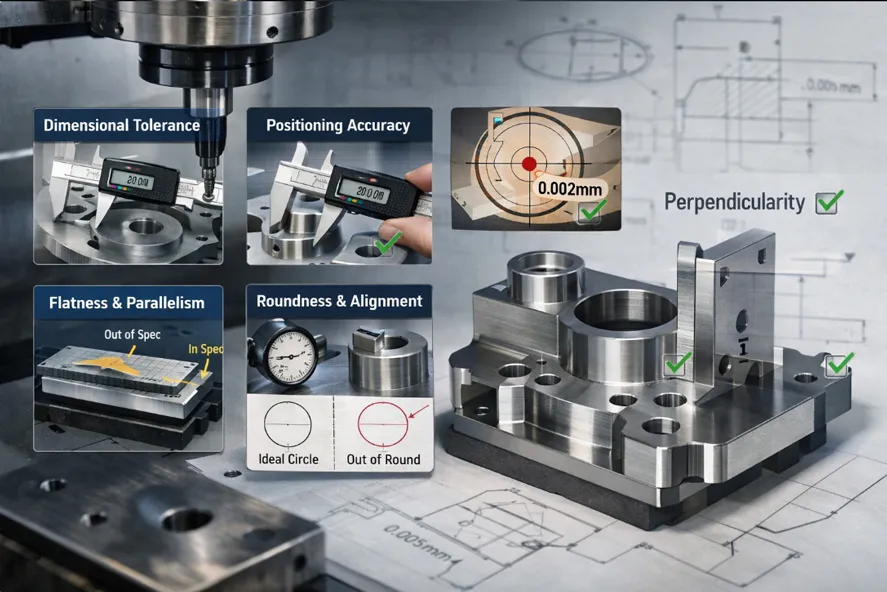
When you use cnc machining, you want each part to look like the design. Geometric accuracy means the part has the right size, shape, and spot. You check this by seeing if the part matches the blueprint or digital model. To get high cnc machining geometric accuracy, you must control every step. This means setting up the machine right, picking good tools, and checking your work. Good accuracy helps you meet tight tolerances and makes sure your parts work well.
Tip: Always check your machine before you start. A machine that is set up right gives better accuracy and fewer mistakes.
Difference Between Precision and Accuracy
People talk about precision and accuracy in cnc machining. These words sound alike but are not the same. Knowing both helps you make better parts.
Precision means your results are the same each time. If you make many parts and they all match, you have high precision.
Accuracy means your part is close to the design. If your part fits the plan, you have good accuracy.
A cnc machine can be precise but not accurate. For example, you might make many parts that are all the same, but they are all too big or too small.
When you set a tolerance, you pick how much error is okay. Tight tolerances need both high precision and high accuracy. This is why you must check both when you look at your parts.
How Geometric Accuracy Impacts Final Part Quality
Impact on Fit and Function
You want your parts to fit well. There should not be gaps or too much force. When you control cnc machining geometric accuracy, each piece matches the design. This helps you stop problems when putting things together. Geometric tolerances show how much a part can change from the plan. If you use tight tolerances, parts fit better and move smoother. Here are some ways accuracy helps fit and function:
Geometric accuracy is needed for parts to fit and work together in assemblies.
Tolerances show how much size can change, which is important for parts to work together.
In important industries, even small mistakes can hurt safety and how things work.
Very strict tolerances may need more machining steps, which costs more and takes longer.
Loose tolerances can make assembly hard, so you may need to fix parts or throw them away.
Reliability and Performance
You want your parts to work every time. High-precision cnc milling makes parts stay in the right tolerance. When you use precision and accuracy, you lower the chance of failures. Studies show that smart systems can cut costs and make things more reliable. For example, accuracy reliability went up from 80.75% to 90.01% after using smart systems. You also get fewer failures and products last longer.
Tolerance Type | Description | Functional Impact |
|---|---|---|
Position Tolerances | Checks if a feature's axis is in the right spot | Makes sure parts line up right, which helps them work well |
Flatness | Looks for bumps or dips on a surface | Finds surface problems that can hurt assembly or how things work |
Parallelism | Checks if features are lined up with a reference | Mistakes can cause uneven force and leaks, which hurts reliability |
Profile Tolerances | Checks if surfaces match the CAD shape | Needed for tricky shapes, helps with fluid flow and air movement |
Effects on Assembly and Interchangeability
You want your parts to work in any system and be easy to swap. High accuracy in cnc machining makes sure parts fit together right. This helps you put things together faster and swap parts without trouble. Precision keeps parts close to the right size. You can trust each part will match the others, so assembly is quicker and works better.
Note: When you use accurate machining, you make quality better and help your products work as they should.
Understanding CNC Accuracy and Tolerances
Geometric Tolerances in CNC Machining
It is important to know about geometric tolerances. These tolerances tell you how much a part can change. They set limits for shape, size, and position. You control more than just size with geometric tolerances. You also control form, orientation, and location. This helps you get good dimensional accuracy. It keeps parts working as they should. If you want strict cnc tolerances, check every detail. Tight tolerances help you stop mistakes. They keep quality high.
GD&T Basics and CNC Interpretation
GD&T stands for Geometric Dimensioning and Tolerancing. You use GD&T to show what you want from each part. GD&T helps you talk about cnc machining geometric accuracy. You use symbols and numbers to set rules for features. Here is what GD&T controls:
Form: Shapes like flatness and circularity stay correct.
Orientation: Features line up, like parallelism and perpendicularity.
Location: You set the spot for holes or slots.
Runout: You check how features spin or rotate.
GD&T uses a datum reference frame. This gives you a steady base for checking parts. Feature control frames show what you need for each feature. This makes drawings easy to read. Machinists can make the right choices. You get better assembly and performance with GD&T and cnc machine tool tolerance.
Measurement Standards and Definitions (ISO, ASME)
You need standards to check your work. ISO and ASME give rules for cnc machining. Here is a table that shows how ISO 2768 helps:
Aspect | Details |
|---|---|
Standard Name | ISO 2768 |
Relevance | Sets tolerance values for geometric features in CNC machining. |
Impact on CNC Machining | Helps make parts with needed accuracy, lowers defects and reworks. |
Specifics | ISO 2768-1 gives general tolerances for linear and angular dimensions of workpieces. |
ASME Y14.5 is used for geometric tolerances. This standard helps you set clear rules for design and inspection. When you follow these standards, you get better precision. You make fewer mistakes. Your machining meets project needs and keeps parts working well.
Tip: Always check standards before you start. This helps you avoid errors and keeps quality high.
Factors Affecting CNC Machining Accuracy
Many things can change how accurate your CNC parts are. You need to know these factors to keep your parts good and meet tight tolerances. Let’s see what affects cnc machining geometric accuracy.
Machine Geometry and Calibration
The shape and setup of your CNC machine matter a lot. You must check and adjust your machine often to keep it accurate.
Axis alignment & backlash
If the axes are not lined up, your parts will have errors. Backlash is a gap between moving parts in the system. This makes the tool move too much or not enough. You need to check for backlash and fix it to keep your tolerance tight.
Tip: Always check axis alignment before you start a job. This helps you avoid mistakes and keeps your precision high.
Here is a table that shows how measurement and calibration affect your results:
Evidence Point | Description |
|---|---|
Measurement Process Evaluation | The measurement process checks the quality of the system, not just the part. |
Calibration Methods | Accurate calibration, like laser interferometry, fixes errors in linear axes and boosts precision. |
Dynamic Factors | Moving parts and machine speed can change how well your machine holds geometric accuracy. |
Temperature and thermal influence
Heat can change the size of your machine and parts. When the machine gets hot, metal expands. This can make your dimensions wrong. You need to watch the temperature in your shop and use thermal compensation for the best results.
Note: Even small temperature changes can affect the accuracy of your CNC system.
Here is a table of common calibration methods and their pros and cons:
Calibration Method | Pros | Cons |
|---|---|---|
Manual Calibration | Cheap, no special equipment needed | Takes time, more chance for human error |
Ballbar Calibration | Finds machine problems with high accuracy | Needs special, costly equipment |
Laser Interferometer Calibration | Very accurate, finds tiny errors | Expensive, needs a skilled technician |
Probing System Calibration | Faster setup, less human error | Needs special probes, adds cost |
Software-Based Calibration | Automatic, gives deep analysis | Only as good as the software, may miss issues |
Thermal Compensation Calibration | Keeps accuracy in changing temperatures | Needs sensors and software, hard to set up |
Dynamic Calibration | Shows real-world accuracy, improves performance | Complex, needs advanced equipment |
Tool Wear and Setup
Your tools and how you set up your machine also change the quality. You must check your tools and setup to keep your parts inside the right tolerances.
Tool wear effects
Cutting tools wear down as you use them. This can make your parts less accurate and hurt the surface finish. Tool wear can also make cutting forces go up, which can change the shape of your part.
Tool wear increases cutting forces, which lowers precision.
High temperatures from worn tools can make accuracy worse.
Worn tools can make parts that do not meet dimensional tolerances, so you may need to scrap or rework them.
Too much tool wear can make the surface rough and lower the quality.
If you do not catch tool wear in time, you can have accidents and lose money.
Clamping and fixture setup
How you hold your part in the machine matters. If you do not clamp your part right, it can move or bend. This will make your dimensions wrong. You should use soft jaws, spread out support, and vacuum or magnetic hold-downs to protect your part. Place clamps on the strongest parts of your workpiece. Avoid putting too much force on thin or flexible areas.
Use kinematic locators and machined datums for accurate re-indexing.
Standardize clamp force and placement for repeatable results.
Match clamping force to the material and cutting load to stop distortion.
Material and Operational Variables
The material you use and how you run your CNC system can change your results. You need to know how these things affect your machining.
Material deformation
Different materials act in different ways. Harder materials can wear out your tools faster. Softer materials can change shape more easily, which can make your parts the wrong size. Material springback means the part tries to go back to its old shape after you cut it. This can hurt your accuracy.
Contributing Factor | Description |
|---|---|
Machine Compliance | The machine can bend or flex during operation, which changes the final dimensions. |
Material Springback | The material may return to its old shape after cutting, which affects accuracy. |
Tool Compliance | The tool or holder can bend, which changes the cut. |
Programming Errors | Mistakes in the CNC program can make the part the wrong size. |
Vibrations and cutting forces
Vibrations and strong cutting forces can make your part move or shake. This can cause errors in the final dimensions. You need to set the right feed rates, spindle speeds, and depth of cut to lower these problems. If you use the wrong settings, you can get tool deflection or workpiece deformation.
Alert: Programming errors, tool wear, and machine calibration drift can all lead to parts that do not meet your tolerance or quality needs.
Material properties, human error, and operational mistakes all play a role in the quality of your CNC machining. You must check each step to keep your performance and precision high.
Consequences of Poor vs High CNC Accuracy
Cost and Rework
If cnc machining geometric accuracy is low, costs go up. Mistakes happen and you need extra work to fix them. You spend more time fixing errors and making finishing passes. Tools wear out faster, so you replace them more often. Special setups and fixturing take longer, which adds to setup time. Checking parts and quality takes more steps, so lead times get longer. Labor costs rise as you try to meet material and surface finish needs.
More time spent on finishing passes.
Tools wear out and cost more to replace.
Extra setups and fixturing are needed.
More steps for checking quality.
More labor for material and surface finish.
High precision means less rework is needed. Fewer setups help avoid alignment mistakes. Careful planning makes parts fit together without extra work. You control how materials act, so you stop deformation and costly fixes.
High accuracy lowers setup mistakes.
Good planning helps parts fit without extra work.
Controlling materials stops deformation.
Application Suitability
You must match cnc accuracy to your job. Some industries need tight tolerances and high quality. Aerospace and automotive need critical precision for safety and performance. Even small mistakes can cause assembly errors. You need exact measurements to stop functional failures.
Industry | Requirement for Geometric Accuracy |
|---|---|
Aerospace | Needs critical precision for safety and performance |
Automotive | Needs tight tolerances for reliability and function |
Geometric accuracy is needed for important jobs.
Small mistakes can cause assembly errors.
Tight tolerances stop functional failures.
Warranty and Field Failures
If cnc accuracy drops, you risk warranty claims and failures. Operator mistakes can hurt the system and make the machine lose precision. You must realign and check machines after these problems. These issues make warranty claims harder, especially if the problem is not from design flaws. You see more warranty claims early on because of misuse.
If you keep high accuracy, you lower failures and warranty problems. You protect your reputation and keep customers happy.
Achieving High-Precision CNC Milling
Process Optimization Techniques
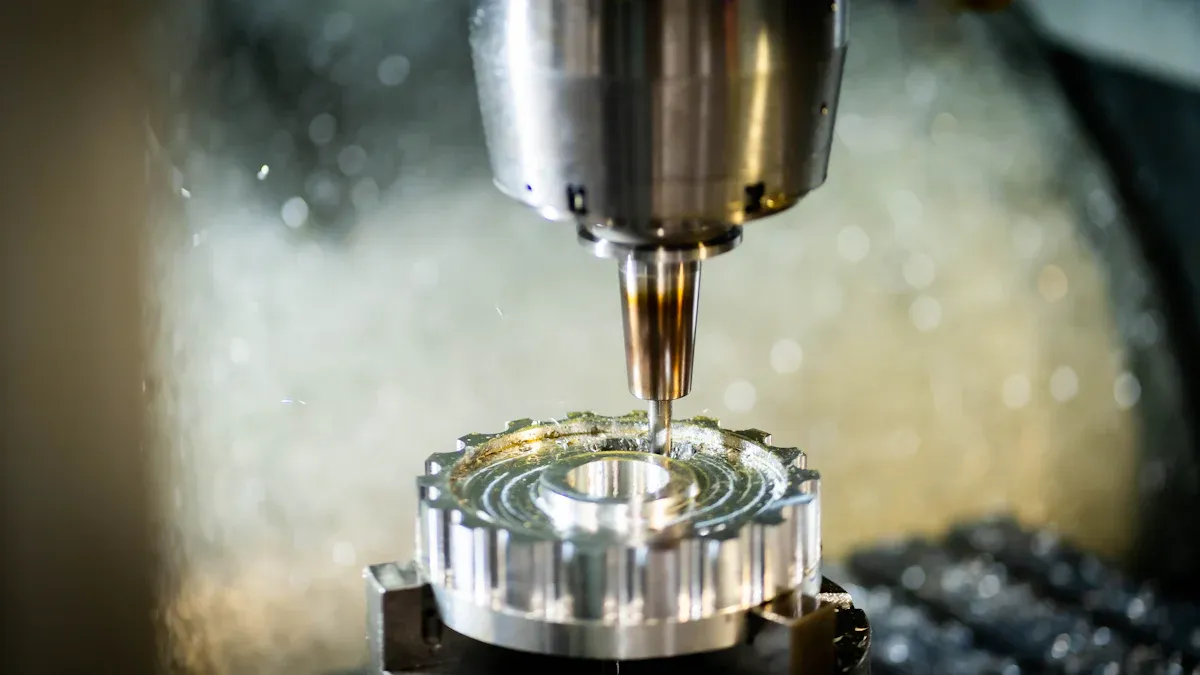
You can make cnc machining geometric accuracy better by using smart methods. These ways help you get good results and keep your system working well. The table below shows some proven methods:
Technique | Description |
|---|---|
Toolpath Smoothing | Makes tool moves smoother for better finish and accuracy. |
Tool Axis Vector Optimization | Keeps tool movement steady to lower errors. |
Layered Machining Strategies | Uses roughing, semi-finishing, and finishing steps to control stress. |
Advanced Error Compensation | Uses RTCP to fix errors in five-axis machining. |
These strategies help your cnc parts meet tight tolerances and high quality. Each step helps you control how things work and lowers mistakes.
Advanced Measurement and Inspection (CMM, laser scanning)
You need to check your parts with advanced tools to keep high-precision cnc milling on track. CMMs and laser scanning give you many benefits:
CMMs use laser scanning to collect lots of data for surface maps.
You can compare your parts to CAD models for quick quality checks.
These tools help you make sure every part meets the right tolerance and design.
Fast inspections mean less downtime and more production.
Precision measurement lowers errors, waste, and rework.
You can trust these tools to keep your machining process accurate and efficient.
Standardized Tolerances and Best Practices
You should follow best practices and use standardized tolerances to get the best results in cnc machining. Here are some tips:
Start with simple CAD models and standard tool sizes.
Modern cnc machines can reach tolerances as tight as ±0.002 inches.
Use GD&T for complex features to keep alignment and position correct.
Use CMMs for accurate measurements.
Remember, softer materials may need wider tolerances because they can deform.
If you follow these steps, you will boost quality and keep your parts working as they should.
Tip: Always check your process and tools before you start. This helps you keep accuracy and performance high.
Choosing the Right CNC Partner for Precision Parts
You need a CNC partner you can trust. This helps you get the best parts. The right shop lets you reach tight tolerances and high precision. When picking a provider, look for skill in cnc machining geometric accuracy. You can check services like CNC machined parts to find what fits your needs.
What to Look for in a High Precision CNC Shop
You want a shop that keeps accuracy steady and gives you good parts. Use these points to check a CNC shop:
Criteria for Evaluation | Description |
|---|---|
Stability of geometric accuracy of the machine tool | Makes sure the machine works well all the time. |
Accuracy of spindle | This affects how precise the machine is. |
Quasi-static errors stable | Looks at how heat and outside forces change measurements. |
Vibration sources | Finds things that shake and can hurt accuracy. |
Cleanness of the working space during measurement process | A clean area stops dirt and mistakes during checks. |
Resolution of elements related with the design | Better resolution parts help make things more accurate. |
Calibration of the TP and the standards used | Regular checks keep measurements correct and trustworthy. |
Ask about how the shop checks their machines and stops vibration. Clean work areas help avoid mistakes. Machines with high resolution make better parts.
Quality Certifications and Reporting
You need to see if the shop has certifications. These show they follow strict rules. Look for these:
ISO 9001: This means the shop uses a worldwide quality system.
AS9100: This is for aerospace and adds extra safety and quality steps.
Shops with these certificates work to get better all the time. They keep quality high and make sure your parts meet tight tolerances.
Communication and Design Support
Good communication helps you stop mistakes in cnc projects. You want a partner who explains tolerances and listens to you. Good design support helps you make parts that are precise and accurate.
Clear talking stops confusion and errors.
Not understanding tolerances can lead to expensive fixes.
Design help lets you make parts that meet exact needs.
Pick a CNC partner who gives advice and answers your questions. This help lets you get the best results in machining.
FAQ
What tolerances can CNC machining achieve?
You can reach very tight tolerances in cnc. Most shops can hold tolerances of ±0.005 inches. Some advanced machines can go as tight as ±0.002 inches. If you need extreme accuracy, you may see tolerances as close as ±0.0005 inches. The type of material and the part shape can change what is possible. Always check the needs of your project before you set your tolerance.
Tip: Talk to your machinist about tolerances in cnc milling before you start. This helps you avoid mistakes and extra costs.
How does tool wear affect geometric accuracy?
Tool wear changes the way your machine cuts. As tools wear down, they lose their sharp edge. This can make your parts the wrong size or shape. You may see rougher surfaces or small errors in the final part. You should check your tools often and replace them when needed. This keeps your cnc machining geometric accuracy high.
Why is geometric accuracy important for final parts?
Geometric accuracy makes sure your parts fit and work as planned. If you do not control accuracy, you may see gaps, loose fits, or even broken assemblies. Good accuracy helps you meet safety rules and keeps your products working well. You can trust your parts to last longer and perform better.
How to improve CNC machining precision?
You can boost precision in machining by following these steps:
Calibrate your machine often.
Use sharp, high-quality tools.
Keep your work area clean.
Control the temperature in your shop.
Check your setup and fixtures before you start.
Use advanced inspection tools to measure your parts.
If you follow these tips, you will see better results and fewer errors in your cnc projects.
You help make good parts with your cnc system. If you check form and position tolerance, parts fit and work right. You need to know about perpendicularity and geometric tolerances to stop mistakes. High-precision areas need careful planning and checking. Pick a cnc machining service provider who helps you reach your goals.
Remember, accuracy keeps your products safe and makes assemblies work well.
Look at tolerances and what affects them before each project.
Focus on accuracy and pick the right partner for the best results.