LKprototype
You want your complex parts to work well and not cost too much. Making the geometry better for manufacturability and efficiency is very important in design for CNC machining. Many industry surveys show common mistakes that make costs go up and cause problems with machining.
Thin walls can break or bend, especially if they are less than 0.020 inches.
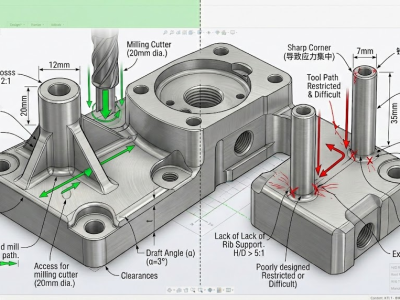
Internal 90-degree corners are hard to make and may need extra tool changes.
Small text and deep holes make machining slower and can break tools.
Tight tolerances should only be used when you really need them.
Curved holes and very tall walls can cause surface quality problems.
You can use design for CNC machining tips and best practices early in your design process. This way, you can avoid expensive mistakes and get better manufacturing results.
Key Takeaways
Pick easy shapes for your designs to make them cheaper and faster to make.
Do not use thin walls or sharp corners so parts do not break and stay strong.
Think about how tools will reach the part and try to use fewer setups to make machining work better.
Pick materials that are easy to machine so you can save time and money.
Talk to suppliers early so your design matches what machining can do.
What Is Design for CNC Machining?
CNC Design for Manufacturability Explained
When you design for CNC machining, you try to make parts that are easy and fast to make. You also want the parts to look good and work well. This is not the same as general design for manufacturing. General design for manufacturing tries to make any product easier to build. It helps lower costs and stops problems.
CNC machining uses very accurate machines to shape materials. If you make your design better, you can save money and make parts faster. You need to think about how the shape of your part will change how the CNC machine works. Simple shapes are easier for the machine to cut. Using standard features means you do not need to change tools a lot.
You can use some main rules to help make your CNC parts better. The table below shows some important ideas:
Principle | Explanation |
|---|---|
Design Simplification | Use simple shapes to lower costs and save time. |
Material Selection | Pick materials that work well with CNC machines to speed up production. |
Surface Finish and Adhesion | Plan for finishes that do not add extra steps or costs. |
Standardization of Components | Use standard sizes and shapes to make machining easier. |
Design with Tooling Access in Mind | Make sure tools can reach all areas of your part. |
Minimize the Number of Setups | Try to finish the part in as few steps as possible. |
Why DfM Matters for Complex Parts
If you use design-for-manufacturing for complex parts, you can get big benefits. You might make CNC parts cost 15–40% less. You can also make lead times 25–60% shorter. If you talk to your supplier early, you can match your design to the machine. This helps you stop mistakes and makes your process better.
You should always think about how your design choices change manufacturing. Good design for CNC machining helps you get the best parts, even when the shapes are hard.
CNC Machining Capabilities Overview
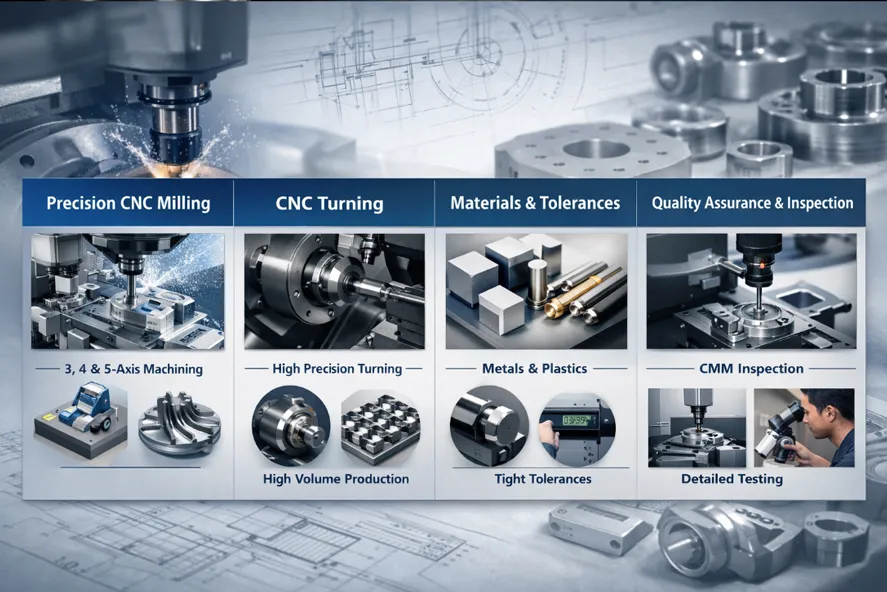
You should know about different machines before you design parts. Each machine can do special things to shape materials. If you want to see examples or need help, you can look at CNC machining services and capabilities.
Types of CNC Machines
CNC milling machines use spinning tools to cut parts. There are different types for different jobs. Here are some common machines:
3-axis mills: These are good for flat shapes and simple parts.
4-axis mills: These can cut around sides and cylinders without moving the part.
5-axis mills: These can make hard shapes and curves in one step. They are used in aerospace and medical fields.
CNC lathes: These make round parts and cost less.
Mill-turning centers: These do turning and milling together. This saves time and money.
Here is a table to compare them:
Type of CNC Machine | Capabilities |
|---|---|
3-axis CNC milling machines | Simple shapes, very accurate, not expensive |
CNC lathes | Makes round parts, lowest price for each part |
Indexed 5-axis CNC milling machines | Makes features not lined up with main axes, very accurate |
Continuous 5-axis CNC milling machines | Makes very hard shapes, smooth curves, costs more |
Mill-turning CNC centers | Does turning and milling, makes hard parts, costs less than other 5-axis machines |
Axis Movement and Tool Access
The number of axes changes what you can make. A 3-axis mill moves in three ways. You have to move the part a lot for new cuts. A 4-axis machine can spin the part to cut around it. A 5-axis machine adds two more spins. You can reach almost any spot on the part. This helps you make tricky shapes and smooth sides.
Tip: More axes mean you need fewer steps and can reach tough spots.
Limits of CNC Machining
All machines have limits. You need to know these before you start. The work envelope is the biggest size your part can be. Axis travel is how far the tool can move. Tool reach and how you hold the part change what shapes you can make. Tolerances start at ±0.1 mm, but special setups can get to ±0.01 mm.
Aspect | Details |
|---|---|
General Tolerances | ±0.1 mm is normal, up to ±0.01 mm with special setups |
Work Envelope | Sets the biggest part size |
CNC Axis Travel | Shows how far the tool can go in X, Y, Z |
CNC Milling Size Limits | Set by work envelope and tool reach |
CNC Turning Size Limits | Set by center distance, swing distance, and how you hold the part |
You can make better parts if you know what each CNC machine can do and where the limits are.
CNC Design Rules for Complex Geometry
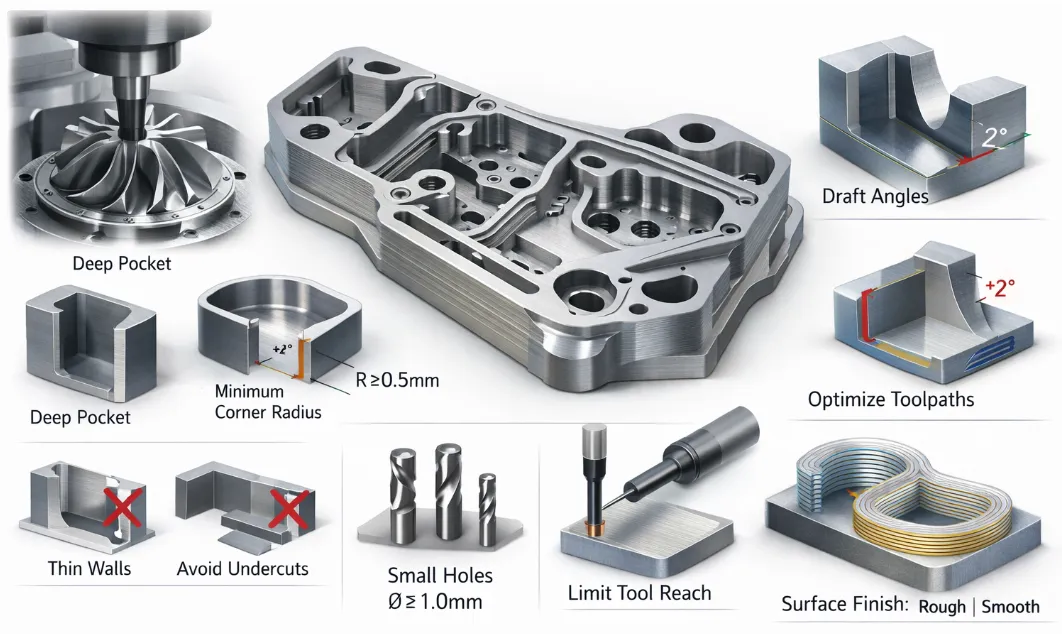
Wall Thickness and Thin Walls
When you design cnc machined parts, wall thickness is important. Thin walls can bend or break while being made. The right wall thickness depends on the material you use. The table below shows the best thickness for some materials:
Material | Minimum Wall Thickness | Maximum Wall Thickness |
|---|---|---|
Brass | 0.5 mm | 12 mm |
Plastics (e.g., ABS, Polycarbonate) | 0.3 mm | 8 mm |
Titanium | 1 mm | 20 mm |
Carbon Fiber Composites | 0.5 mm | 10 mm |
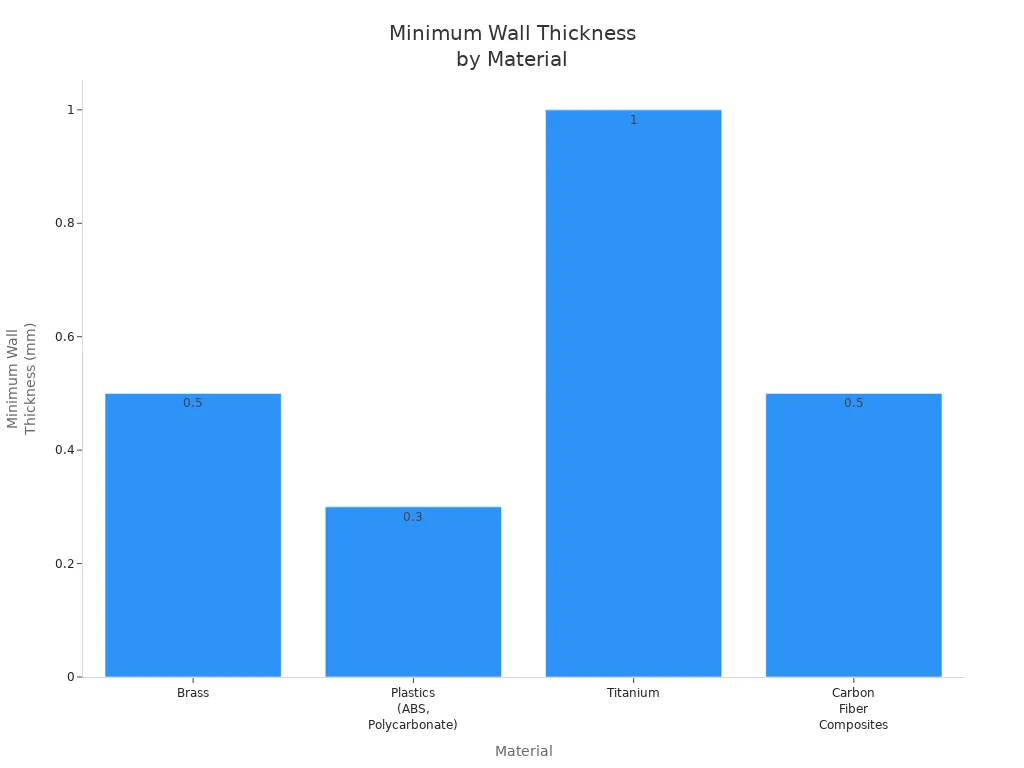
Tip: Use thicker walls for metals like titanium. This helps stop warping. Thin plastic walls can bend out of shape.
Internal Radii and Fillets
Fillets are very helpful in cnc machining design. You should put fillets in inside corners. Fillets help spread out stress and let tools reach better. Sharp corners make stress higher and can cause breaks. Fillets also help make parts faster.
Aspect | Sharp Corners | Fillets |
|---|---|---|
Stress Concentration | High, leading to potential failure | Low, spreads stress more evenly |
Tool Access | Difficult, increases tool wear | Easier, reduces machining challenges |
Manufacturing Efficiency | Low, higher costs due to tool changes | High, improves overall production efficiency |
Fillets help stop cracks from starting.
They are needed for strong cnc machined parts.
Fillets make part shapes change smoothly.
Avoiding Sharp Corners
Sharp corners are not good in cnc machined parts. Try not to use them in your design. Sharp corners make stress points and can break tools. They also make parts weaker and can cause them to fail early.
Inside sharp corners make stress build up.
Parts that get used a lot can break at sharp corners.
Adding radii helps the material move and lowers stress.
Pocket Depth and Slots
Deep pockets and slots are seen in many complex parts. You should not make pockets too deep. If pockets are too deep, tools can bend. The deepest pocket should be only 3-4 times the end mill’s width. This keeps the part accurate and smooth.
Note: Deep pockets need careful design. This stops tools from wearing out and keeps sizes correct.
Symmetry and Balanced Features
Making parts symmetrical helps a lot in manufacturing. Symmetrical parts are easier to hold and turn while machining. This makes setup faster and saves money.
Symmetrical parts are made faster.
Balanced features help avoid mistakes and make parts better.
Long and Thin Components
Long and thin parts are hard to machine. You need to hold these parts tightly so they do not bend. Special holders or soft jaws can help support thin parts. Picking the right cutting tools stops shaking and bending.
Thin aluminum parts can bend because they are not stiff.
Too much shaking makes the surface rough and tools wear out.
Heat can change the size of parts; making both sides at once helps with heat.
Tip: Careful quality checks help keep complex shapes accurate.
Feature-Specific CNC Design Guidelines
Holes, Threads, and Lettering
There are special rules for holes, threads, and lettering in cnc machining. If you put holes in the right spots, you save money. It also makes the part easier to make. Use drill bits that are a common size for holes bigger than 1 mm. Do not make deep holes more than four times as deep as they are wide. You can go up to ten times if you really need to. Threads work best if you use M6 or bigger. Make threads at least 1.5 times as long as they are wide. Three times is even better because it makes them stronger. For lettering, use a font size of 20 or more. The letters should be at least 5 mm deep so you can see them clearly.
Category | Recommendation | Details |
|---|---|---|
Holes | Diameter | Use standard drill bits; feasible for diameters larger than 1 mm. |
Maximum depth | Recommended: 4 times nominal diameter; typical: 10 times; feasible: 40 times. | |
Threads | Thread size | Minimum: M1; recommended: M6 or larger. |
Thread length | Minimum: 1.5 times nominal diameter; recommended: 3 times nominal diameter. | |
Lettering | Font size | Recommended: 20 or larger, with 5 mm engraved. |
Tip: Put holes away from the edges and corners. This stops cracks and helps tools reach the holes.
Deep Cavities and Complex Features
You need to plan carefully for deep cavities and complex shapes in cnc. The shape of your part changes how you hold it while making it. Thin walls can break, so keep them thick enough to stay strong. Tools need to reach deep spots, but long skinny tools can bend or shake. Keep the depth less than four times the width to stop chips from getting stuck and tools from jamming. Make inside corners round to help tools last longer and make the surface smoother.
Design Consideration | Explanation |
|---|---|
Geometry | The geometry of a part dictates how it will be held during machining, affecting tool access and stability. |
Wall Thickness | Thin walls present challenges in machining, requiring careful consideration to avoid breakage and ensure precision. |
Tool Access | Access to tools is crucial for deep cavities; long, slender tools are prone to deflection and require careful management. |
Depth-to-Width Ratio | Keeping the depth-to-width ratio below 4:1 is recommended to prevent issues with chip evacuation and tool binding. |
Internal Corners with Generous Radii | Designing corners with radii reduces tool wear and improves manufacturability, leading to better surface finishes. |
Use balanced shapes to make the part easier to machine.
Plan tool paths so tools can reach every spot without extra steps.
Note: Check your design for deep cavities and tricky shapes before you send it for cnc machining. This helps you not make expensive mistakes.
CNC Machining Tolerances Explained
When you design cnc parts, you need to know about tolerances. Tolerances show how much a part’s size can change and still work. They help your parts fit together and do their job. Good cnc design always uses the right tolerance for each part.
Standard CNC Machining Tolerances
Tolerances in cnc machining tell you the allowed size range. There are different types of tolerances:
Unilateral Tolerance: The size can change in one way only.
Bilateral Tolerance: The size can change in both ways.
Limit Tolerances: You set the smallest and biggest sizes allowed.
Many companies use standards to keep things clear. Here is a table with two common standards:
Standard | Description |
|---|---|
ISO 2768-1 | Sets general tolerances for length and angle measurements. |
ISO 2768-2 | Sets rules for surface roughness and finish grades. |
You should pick the right tolerance for your part’s job. This helps you keep quality high and costs low.
When to Tighten or Relax Tolerances
You do not need tight tolerances everywhere. Use strict tolerances only when you need a perfect fit or movement. For example, use them on parts that must seal or line up just right. If a feature does not change how the part works, you can relax the tolerance. This makes machining faster and cheaper. Good design means you match each tolerance to what the part needs. Too many tight tolerances can waste money and slow down production.
Tip: Always check which features need tight tolerances. Relax the rest to save time and cost.
Tolerance Stack-Up Considerations
When you put many parts together, small size changes can add up. This is called tolerance stack-up. If you do not plan for this, your assembly may not fit or work right.
If you do not check tolerance stack-up, you can have big problems. These problems can cause assemblies to fail, cost more money, and upset customers.
You must check how each part’s tolerance affects the whole assembly.
Tolerance stacking helps you avoid gaps or parts that do not fit.
Always review your design and steps to control stack-up.
Engineers see this problem a lot in aerospace, defense, and medical devices. The parts meet their own specs, but the assembly fails because the designer did not check how tolerances add up.
If you understand tolerances, you can make better choices in your cnc projects and avoid costly mistakes.
Material Selection for Complex CNC Parts
Metals vs Plastics in CNC Machining
When you design cnc machined parts, you pick metals or plastics. Metals are strong and last a long time. Plastics can bend more and cost less. Each one is good for different jobs. Here are some plastics you might use:
Acrylonitrile Butadiene Styrene (ABS): This plastic is tough and does not break easily. People use it in things like car parts and products at home.
Polyethylene (PE): This plastic is strong and does not get hurt by chemicals. It works well for parts that hold weight or stay outside.
Polyoxymethylene (POM): This plastic is slippery and does not wear out fast. It is good for moving parts like gears.
Metals like aluminum, stainless steel, brass, and titanium are used a lot. They are strong and can be made very exact. You should pick the material that fits your part’s needs.
Material Impact on Design
The material you choose changes how you design and make parts. Some materials are easy to cut and need fewer tool changes. This makes the surface look better. Other materials are slow to cut and wear out tools faster. You have to think about how strong, cheap, and easy to cut the material is.
Tip: If a material is easy to cut, you can finish parts faster and save money.
Think about these things:
Tool wear rates: If tools last longer, machining is easier.
Chip form: Short chips are simple to clean up.
Surface finish: Easy-to-cut materials make smoother parts.
How easy a material is to cut depends on its heat, strength, and other properties. Harder materials are harder to machine. Soft materials can make long chips that are hard to handle. If you need less force and heat, machining is easier.
Best Materials for Complex CNC Machining
You want the best materials for parts that must be exact and work well. The table below shows some top choices and what they are good at:
Material | Key Properties | Applications |
|---|---|---|
Aluminum | Strong, light, easy to cut, not expensive | Electronics, medical devices, aerospace |
Stainless Steel | Does not wear out, very exact, lasts long | Medical tools, airplanes |
Brass | Smooth finish, easy to cut, does not rust | Bathroom parts, locks, art |
Titanium | Very strong, lasts long, does not rust | Airplanes, sports gear, jewelry |
Engineering Plastics | Bends without breaking, cheap, good for testing | Making test parts |
Note: Aluminum is picked a lot for cnc machined parts. It is strong, easy to cut, and not too expensive.
You should pick your material based on what your part needs and how hard it is to make.
Cost-Saving Strategies in CNC Design
Minimize Setup Changes
You can save time and money by reducing the number of setup changes during cnc production. Each setup takes time and can lead to mistakes. To minimize setups, follow these steps:
Measure and record the current state of your machine and job.
Identify and time each step that affects setup, such as cleaning and tool selection.
Prepare tools and materials before starting the job.
Group similar parts together to avoid changing the machine too often.
Calibrate machines using clear instructions.
Check the first part for accuracy and adjust if needed.
Write down and standardize your process for future use.
Modern technology helps you make setups faster. Digital records, built-in probes, and modular workholding systems let you prepare jobs offline. This means your machine spends more time making parts and less time waiting.
Tip: Organize your workspace and use digital tools to keep setup changes quick and easy.
Reduce Tool Changes
Cutting down on tool changes is another way to lower costs in cnc work. Every tool change stops the machine and adds to the total time. You can:
Use fewer tools for more operations.
Plan your process to finish as much as possible with each tool.
Choose tools that can handle multiple tasks.
Fewer tool changes mean less downtime. You also lower the risk of errors during setup. This leads to fewer defects and less rework. When you reduce tool changes, you also cut down on tool wear and speed up the whole process.
Optimize Cutting Paths
Optimizing cutting paths makes cnc machining faster and helps your tools last longer. The way you plan the tool path affects cutting forces, chip removal, and heat. Good tool paths keep the process smooth and safe.
Strategy | Benefits |
|---|---|
Tool Path Optimization | Increases efficiency and tool life while keeping quality high. |
Shortening Machining Cycle Time | Reduces empty tool movement and boosts material removal rate. |
Reducing Tool Costs | Lowers tool wear and saves money. |
Improving Surface Quality | Prevents chatter, overcutting, and burrs. |
You can use special tool paths, like trochoidal paths, to keep the tool engaged at the right angle. This helps with chip removal and reduces heat. When you plan your cutting paths well, you get better surface finishes and longer tool life.
Note: Always review your cutting paths to make sure they are efficient and safe for your parts.
Overcoming CNC Machining Challenges
Tool Deflection and Vibration
Tool deflection and vibration can cause problems in cnc. Thin walls make tools bend more. This can lead to rough cuts and more shaking. Aluminum vibrates longer because it does not soak up energy well. If you use thin walls, tools will bend even more. You can fix these problems by doing a few things:
Make your work-holding setup strong so the part does not move or shake.
Change your speeds and feeds to keep things steady.
Use thicker tool shanks to stop tools from shaking and bending.
If you pick strong tool materials like carbide and use short, thick tools, you will get better accuracy and smoother parts.
Warping and Deformation
Warping and deformation can mess up thin or detailed cnc parts. You can stop these problems if you follow some easy steps:
Use at least 1.5 mm wall thickness for aluminum and 2.5 mm for plastics.
Add small ribs, about 3-5 mm wide, every 25-50 mm to make the part stronger.
Pick stable materials like 7075 aluminum for better results.
Use vacuum fixtures or soft jaws to spread pressure evenly.
Set your machine to take shallow cuts, between 0.5 and 1.0 mm, and use high speeds with low feed rates.
These steps help keep your parts from bending or warping during cnc.
Difficult Features in CNC
Some shapes are always hard to make with cnc. Tools cannot always reach every spot on tricky parts. You can use special CAD/CAM software to check your design before you start. Tight tolerances are also hard, especially if you make lots of parts. Calibrate your machines often and use good tools to keep things accurate. Thin walls can bend, so make them stronger and change your cutting settings. If you use tough materials like titanium, pick the right tools and plan your work. When your part needs to fit with others, use exact measuring tools and think about using modular design.
If you plan well and set up your machine the right way, you can solve most cnc problems and make great parts.
CNC vs Other Manufacturing Methods
CNC vs 3D Printing Design Differences
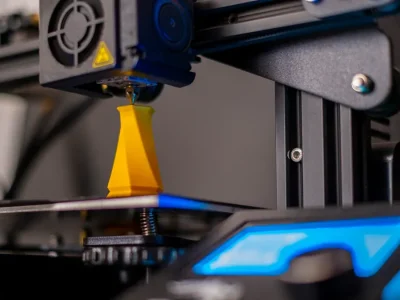
You might wonder how design rules change for cnc and 3D printing. 3D printing lets you make very complex shapes. You can add small details and inside spaces without worrying about tool access. This method lets you build parts with almost no shape limits. You do not have to plan for many setups or tool changes. 3D printing is great for making tricky shapes easily.
CNC machining works better for simple designs. You must think about tool access and how many setups you need. CNC cannot make every shape. It is hard to make hollow parts or deep inside spaces. How complex your part is matters when you pick a method.
3D printing makes detailed shapes and inside features.
CNC machining has limits because of tool access and setups.
3D printing can make parts with few shape rules.
CNC is best for simple designs.
Tip: If your part is very complex, 3D printing might be best.
CNC vs Injection Molding Design Rules
You should also know how cnc and injection molding are different. CNC gives you lots of design freedom. You can change your design fast by updating the CAD file. You do not have to stop work or make new tools. Injection molding needs new molds for every change. This costs more money and takes more time.
CNC costs more for each part but less to start. Injection molding is cheaper per part if you make many, but molds cost a lot. CNC is good for small batches or custom parts. Injection molding is better for making lots of parts fast with many-cavity molds.
CNC works with many plastics and metals.
Injection molding mostly uses thermoplastics, elastomers, and thermosets.
CNC gives better accuracy and detail.
Injection molding is less exact and cannot change designs after the mold is made.
Note: Pick cnc for custom or small batches and injection molding for big runs.
FAQ
What tolerances are achievable in CNC machining?
You can achieve tight tolerances with cnc. Most shops offer standard tolerances of ±0.1 mm. If you need more precision, you can request tolerances down to ±0.01 mm. These tighter tolerances require special setups and careful measurement. You should always check with your supplier about what is possible for your design. Tighter tolerances may increase cost and production time.
Tip: Use tight tolerances only for features that need exact fits or movement.
How to avoid deformation in thin wall CNC machining?
Thin walls can bend or warp during cnc. You can avoid deformation by making walls thicker. For metals, use at least 1.5 mm thickness. For plastics, use 2.5 mm or more. You can add ribs to support thin walls. Use soft jaws or vacuum fixtures to hold parts gently. Take shallow cuts and use high speeds with low feed rates. These steps help keep your parts strong and accurate.
Add ribs every 25-50 mm for extra support.
Choose stable materials like aluminum 7075.
What are the key CNC design rules for deep pockets?
Deep pockets need careful planning in cnc. Keep the depth less than four times the tool width. Use rounded corners instead of sharp ones. This helps tools last longer and makes the surface smoother. Make sure tools can reach all areas without extra setups. Avoid thin walls near deep pockets. You can use balanced shapes to make machining easier.
Rule | Recommendation |
|---|---|
Depth-to-width | Less than 4:1 |
Internal corners | Use generous radii |
Wall thickness | Keep walls thick |
How does material selection affect CNC machining design?
Material selection changes how you design and make parts. Some materials are easy to cut and need fewer tool changes. Others are hard and wear out tools faster. You should pick materials that match your part’s needs. Easy-to-cut materials help you finish parts faster and save money. Harder materials may need special tools and slower speeds.
Note: Always consider strength, cost, and machinability when choosing materials.
You can make cnc machining better by using good design steps. If you work with machinists, making hard parts gets easier. These tips help you spend less money and get better quality. Check your design and parts for any problems before making them. You can use special tools or ask cnc experts to help you do a better job.