LKprototype
You want to know how hot silicone molds can get. Most silicone molds can handle heat from -60°C to 300°C, which translates to -76°F to 572°F. Premium silicone, known for its silicone mold temperature resistance, works safely at 250°C for extended periods, equivalent to 482°F, and can withstand short bursts up to 300°C.
Silicone molds allow you to bake, cast, and create prototypes.
You need strong silicone mold temperature resistance to prevent issues in high-heat applications.
You can compare silicone with other mold materials, which helps you choose the safest option for your project.
Key Takeaways
Silicone molds can handle heat from -60°C to 300°C. This makes them useful for baking and other jobs.
Pick good silicone molds for stronger heat resistance. This helps keep your projects safe and makes them last longer.
Always look at the temperature limits for your silicone mold. This stops damage and keeps food safe.
Silicone molds can be used again and do not react with things. They are great for cooking and crafting. You do not have to worry about bad chemicals.
Think about how thick and what shape your mold is. Thick molds last longer. Thin molds show more detail but may break sooner.
WHAT IS SILICONE MOLD TEMPERATURE AND WHY IT MATTERS
WHAT ARE SILICONE MOLDS AND COMMON APPLICATIONS
People use silicone molds in many places. You can use them at home or in factories. Silicone molds help shape things for baking, casting, and making models. You see them in kitchens, art rooms, and big factories. Silicone molds are flexible and strong. This makes them good for easy and hard projects.
Baking trays and ice cube molds use silicone. They are safe to use again and again.
Medical tubing and devices use silicone. It does not change when heated or squeezed.
Art and design projects use silicone molds. They help make detailed shapes and are easy to remove.
Silicone is also used in medical devices, cars, electronics, airplanes, and buildings.
Silicone molds work well in many jobs. You can count on them to handle heat and keep their shape.
WHY SILICONE HEAT RESISTANCE IS IMPORTANT IN MANUFACTURING
You need silicone mold temperature resistance for hot jobs. Silicone is special because it stays the same even in very hot or cold places. This is important in factories. You want your products to stay strong and safe.
Silicone tubing works from -60°C to 200°C. You can use it in car engines, planes, and ovens.
Silicone keeps its shape and works well when hot. This stops bending and breaking.
Silicone moves heat well. This helps machines work better and saves energy.
Tip: Pick silicone molds that resist high heat. This keeps you safe and stops bad chemicals from coming out. Your molds last longer and work better, at home or at work.
Silicone rubber stays strong from 50°C to 250°C. You get products that last and meet tough rules. You protect your work and tools when you pick molds with good silicone mold temperature resistance.
SILICONE MOLD TEMPERATURE RANGE: STANDARD VS HIGH TEMPERATURE SILICONE
STANDARD SILICONE TEMPERATURE RANGE
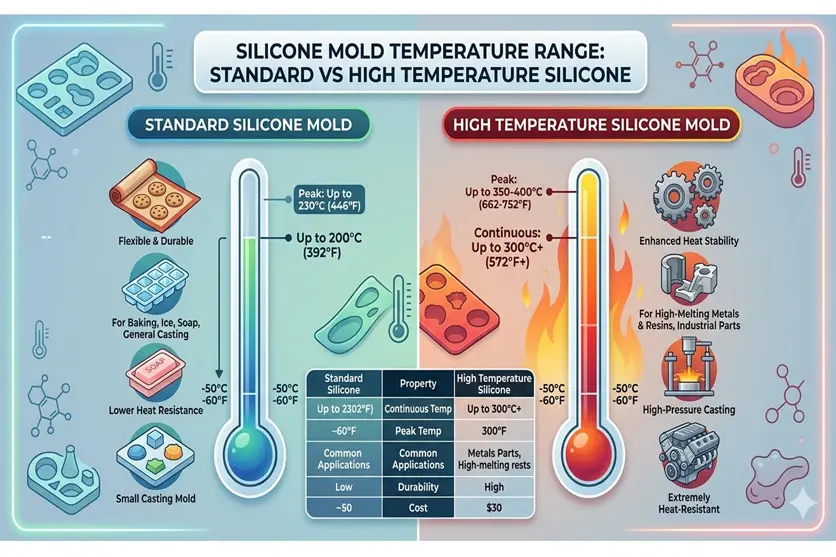
Standard silicone molds are used in kitchens and workshops. These molds can go in the freezer or oven. They work in a wide range of temperatures. Most standard silicone molds work from -73°C to 232°C, or -100°F to 450°F. This means you can use them for baking and crafts. Standard silicone is flexible and lasts a long time.
Temperature Range | Celsius (°C) | Fahrenheit (°F) |
|---|---|---|
Typical Range | -73 to 232 | -100 to 450 |
High-Performance | Up to 315 | Up to 600 |
You can use these molds for baking, making soap, or resin crafts. Standard silicone gives you good silicone mold temperature resistance for most projects.
HIGH TEMPERATURE SILICONE MOLD CAPABILITIES
High temperature silicone molds are used for harder jobs. You see them in factories and for making prototypes. These molds can take heat up to 300°C or even 315°C for a short time. High temperature silicone lasts longer and can be used more times. This makes them great for big jobs and making lots of parts.
Silicone Type | Continuous Use Temp | Peak Temp | Typical Lifespan | Recommended Use Case |
|---|---|---|---|---|
HTV Silicone | Up to 300°C | 315°C | 50–100+ cycles | Industrial tooling, foundry work |
LSR Silicone | 150–200°C | 200°C | 1,000+ cycles | Mass production, medical devices |
HCR Silicone | 180–250°C | 250°C | 100–200 cycles | Heavy-duty industrial applications |
RTV Silicone | 150–200°C | 200°C | 20–50 cycles | Art, crafts, custom molds |
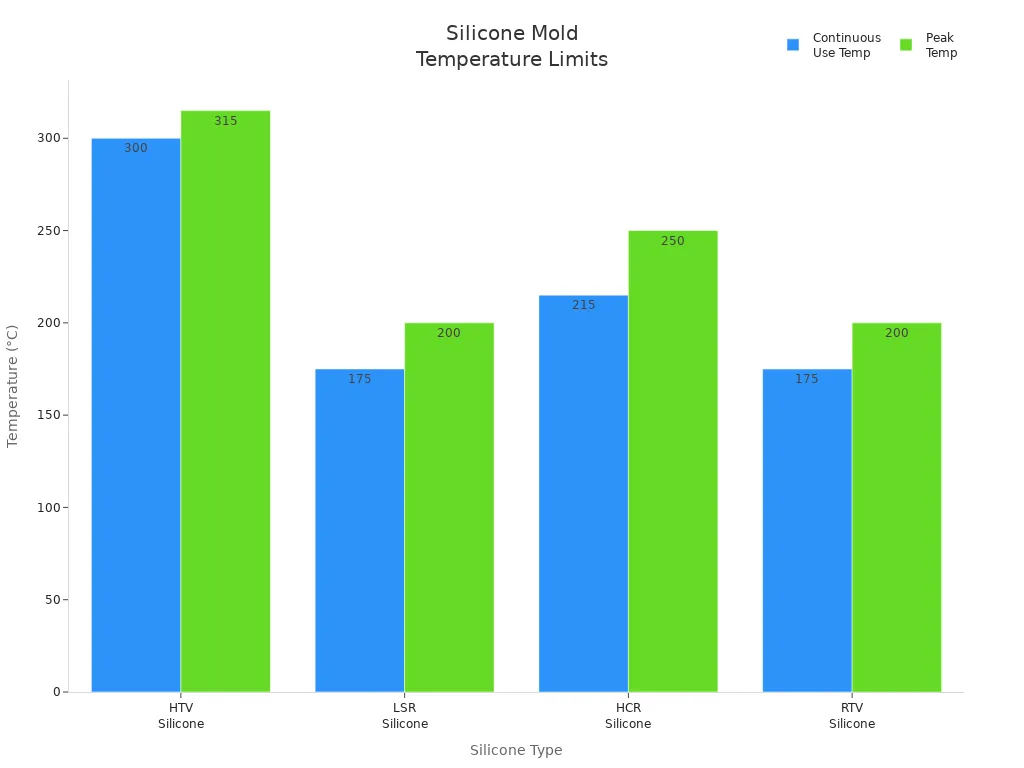
High temperature silicone molds are strong and safe. You can trust them for tough jobs.
CONTINUOUS USE VS PEAK TEMPERATURE LIMITS
It is important to know about continuous use and peak temperature. Continuous use means the mold can stay at a certain heat for a long time. Peak temperature means the mold can take higher heat, but only for a short time. If you use the mold above the continuous limit, it might break or not last as long.
Application | Temperature Range | Key Benefits |
|---|---|---|
Baking | -40°C to 230°C | Non-stick, even heating, freezer-safe |
Cooking (Utensils) | Up to 260°C | Scratch-safe, heat-resistant, hygienic |
Soap Making | Up to 90°C (peak) | Fine detail retention, chemical resistance |
Candle Making | Up to 90°C (pouring temp) | Versatile designs, smooth finish |
Resin Crafting | Up to 80°C (exothermic cure) | Flexible demolding, reusable |
3D Printing (Mold Use) | Up to 200°C | High detail, prototyping efficiency |
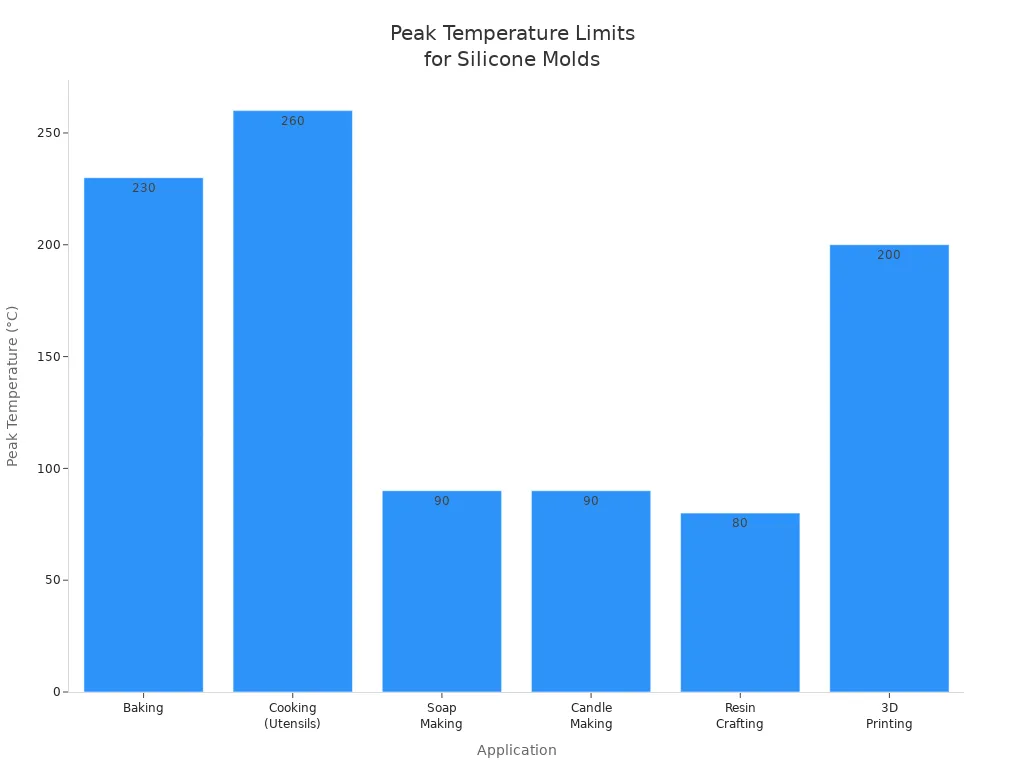
Tip: Always look at the temperature range for your mold. This helps your project and makes your silicone mold last longer.
You get the best results when you pick the right mold for your job. Silicone works for both normal and high heat needs. You can count on silicone mold temperature resistance to keep your work safe and easy.
WHAT TEMPERATURE CAN SILICONE MOLDS WITHSTAND
MAX TEMPERATURE FOR SILICONE MOLDS
You might wonder how hot silicone molds can get. Most silicone molds can handle high heat, but each kind has its own limit. Food-grade silicone is safe up to 448°F. Silicone baking mats can go up to 482°F. If you use silicone bakeware, keep the temperature under 350°F for best results. These numbers help you avoid ruining your mold and keep your food safe.
Material Type | Temperature Limit (°F) | Safety Notes |
|---|---|---|
Food-grade Silicone | Up to 448 | Non-reactive, FDA approved, safe for food contact, but degrades above limit. |
Silicone Bakeware | Up to 350 | No discernible leaching at this temperature according to FDA investigation. |
Silicone Baking Mats | Up to 482 | BPA-free, PFOA-free, does not react with food, no gas emission within limits. |
Silicone mold temperature resistance works well for most kitchen and craft projects.
CAN SILICONE MOLDS GO IN OVEN OR HIGH HEAT ENVIRONMENTS
You can use silicone molds in ovens and other hot places. Silicone does not react with food, even if the food is acidic. The FDA checks food-grade silicone to make sure it is safe. You do not need to worry about bad chemicals when you use these molds for baking or making candy. Silicone molds are safe for preparing food.
Silicone is non-reactive and safe with acidic foods.
FDA has strict rules for food-grade silicone.
Silicone molds are low-risk for making food.
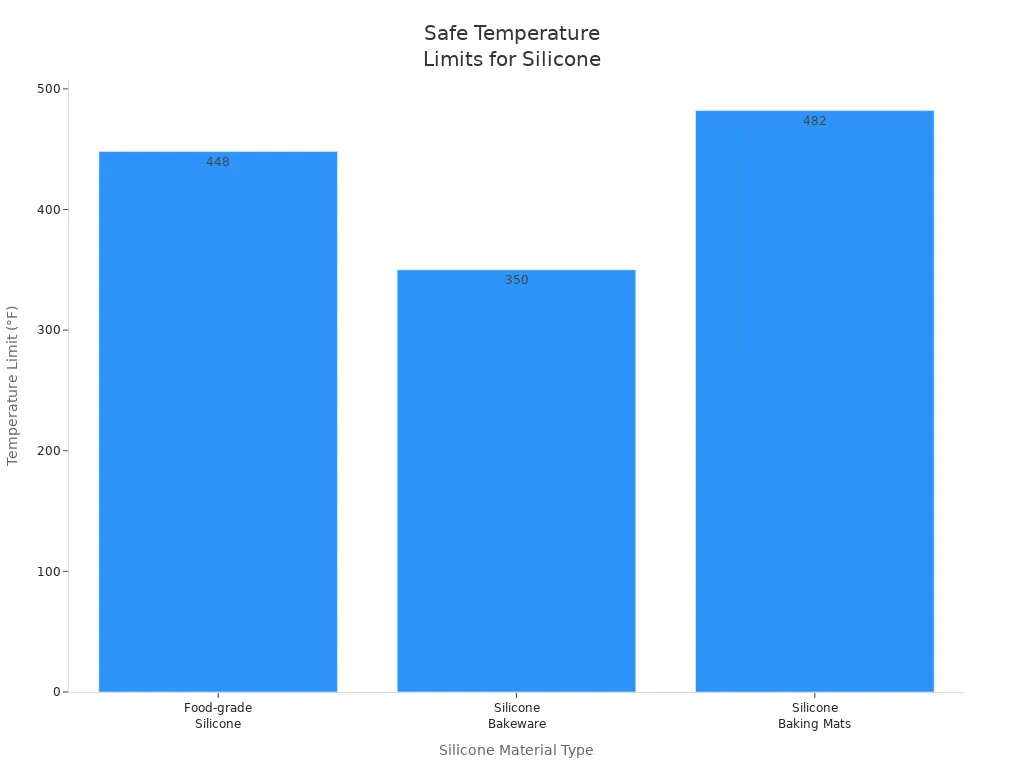
Always check the label for the highest temperature before using your mold in the oven. This keeps your mold strong and your food safe.
SILICONE MOLD MELTING POINT AND FAILURE TEMPERATURE
Silicone does not melt like plastic. It keeps its shape up to about 230°C (446°F). After this, silicone starts to lose its stretch and strength. If you heat it between 250°C and 300°C (482°F–572°F), silicone turns brittle and can break apart. Do not use your molds above these temperatures.
Silicone keeps its shape up to about 230°C (446°F).
Above 230°C, silicone loses stretch and strength.
Between 250°C and 300°C, silicone becomes brittle and can fail.
Silicone gives you strong heat resistance, but you should always stay within the safe range. This helps your molds last longer and keeps your projects safe.
FACTORS AFFECTING SILICONE MOLD TEMPERATURE RESISTANCE
MATERIAL GRADE AND SILICONE QUALITY
You should check the grade and quality of silicone for good temperature resistance. High-quality silicone can handle very hot and cold temperatures without melting or breaking. This makes it great for baking, gaskets, and engine parts. The chemical structure of silicone, called a siloxane backbone, helps it stay flexible and keep its shape in different temperatures. Some types are made to protect things from heat and act as insulators.
Property | Description |
|---|---|
Operating Temperature Range | -130 to +500 degrees Fahrenheit |
Flexibility | Retains flexibility and properties at extreme temperatures |
Chemical Structure | Siloxane backbone and organic moiety, giving strong heat resistance |
Many high-grade silicone molds also work with fuel and oil. This is important for factories and machines.
MOLD THICKNESS AND STRUCTURAL DESIGN
How thick and how your mold is made changes how it handles heat. Thicker molds, usually 8–12 mm or more, are strong and do not bend when hot. They last longer and keep their shape better. Thinner molds, about 3–6 mm, are good for small details but can tear or wear out faster. The design also helps you remove your finished piece and keeps the mold’s shape.
Thicker molds are strong and last longer.
Thinner molds show more detail but can tear.
Good design helps the mold keep its shape and makes it easy to remove your project.
Pick a mold that is tough but still gives you the detail you want.
HEAT EXPOSURE TIME AND ENVIRONMENT
How long your mold is in heat and the place you use it can change how long it lasts. High heat can break down the mold and make it lose its water-repelling and insulating powers. Humidity and sunlight can make this happen faster. If you use your mold in hard places, it might wear out sooner.
Environmental Factor | Impact on Silicone Molds | Key Findings |
|---|---|---|
High Temperature | Makes molds break down faster | Heat breaks the mold’s network and makes it lose its water-repelling and insulation. |
High Humidity | Causes more oxidation | Humidity and heat together make the mold weaker. |
UV Radiation | Speeds up damage | Sunlight and heat together hurt the mold more than one at a time. |
Mechanical Stress | Makes tiny cracks | Squeezing the mold can make small cracks and break it down. |
Tip: Keep your molds away from sunlight and water to help them last longer and keep their silicone mold temperature resistance.
SILICONE HEAT RESISTANCE VS OTHER MOLD MATERIALS
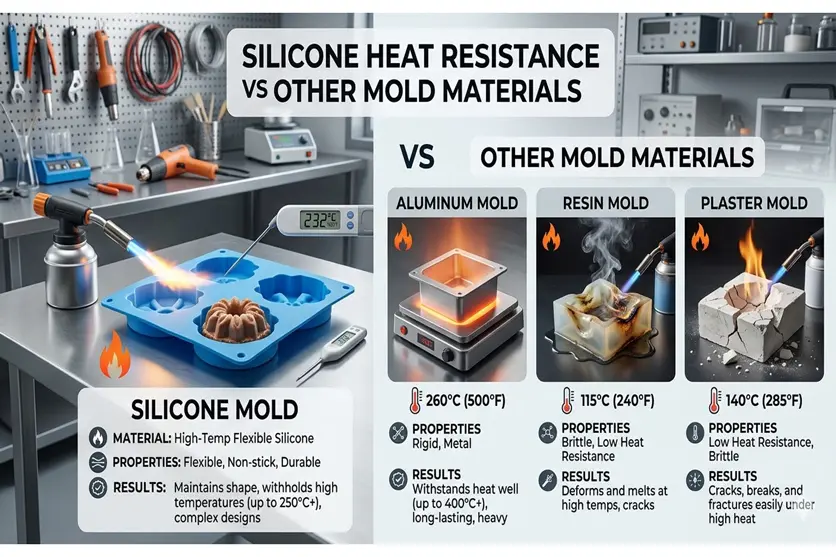
| Mold Material | Heat Resistance Grade | Physical State at High Temperature |
| Silicone | Excellent (Excellent high-temperature stability) | Remains flexible, stable |
| Latex | Poor | Softens, melts, decomposes |
| Common Thermoplastics (PVC, PP) | Poor - Moderate | Softens, deforms, melts |
| Engineering Plastics (PEEK) | Very Good | Remains rigid until melting point |
| Gypsum/Ceramic | Excellent (Excellent refractoriness) | Remains hard, high brittleness, susceptible to thermal shock |
SILICONE VS METAL MOLDS
When you bake or cast, you pick silicone or metal molds. Metal molds can take more heat than silicone. They last longer if you treat them well. Silicone molds spread heat evenly. You can take out cakes easily because silicone bends. Cakes do not stick or break in silicone molds. Metal molds can last longer, but they might rust or bend.
Silicone molds spread heat and make removing food easy.
Metal molds handle more heat but need careful cleaning.
Mold Type | Maximum Temperature | Durability (Years) |
|---|---|---|
Silicone | Up to 560°F (294°C) | 5-6 |
Metal | Higher than silicone | Varies by usage |
SILICONE VS PLASTIC MOLDS
Plastic molds are good for cold things like chocolate or ice. They cannot go in the oven. If you heat plastic molds, they melt or change shape. Silicone molds work in hot and cold places. You can freeze or bake with silicone molds. Silicone does not get ruined by chemicals, fuel, or oil. This makes silicone better for kitchens and factories.
SILICONE VS RUBBER MOLDS
Rubber molds do not work well in high heat. Silicone keeps its shape and strength when casting metals. Rubber molds can crack or melt if they get too hot. Silicone molds last longer and can be used many times. Silicone gives more detail in finished projects. Rubber molds wear out faster and show less detail.
Aspect | Silicone Mold Making | Traditional Mold Making |
|---|---|---|
Durability | High | Varies |
Reusability | Excellent | Limited |
Detail Reproduction | High-detail | Medium-detail |
Turnaround Time | Fast | Slower |
Cost-Effectiveness | High | Lower |
Note: Silicone is a strong elastomer. It stays tough in high heat and does not crack.
COMPARISON TABLE: TEMPERATURE RANGE AND PERFORMANCE
You should look at different mold materials before picking one. The table shows how silicone, plastic, and rubber molds handle heat. It also lists their good and bad points.
Material | Temperature Range | Hardness Range (Shore) | Performance Metrics |
|---|---|---|---|
Silicone | Up to 250°C | 10 A - 90 A | Great for high heat, UV, and ozone; not good for rough use. |
Polyurethane | Up to 80°C | 35 A - 70 D | Gets weaker at high heat; breaks down above 80°C. |
Polycarbonate | 130–140°C | Varies | Works for medium heat; not good for baking or casting metals. |
Silicone is best for high heat jobs. If you need a mold for rough or many uses, check how well it resists tearing.
HOW TO CHOOSE THE RIGHT HIGH TEMPERATURE SILICONE MOLD
PRACTICAL SELECTION TIPS FOR INDUSTRIAL APPLICATIONS
You have to pick the right mold for your project. In factories or workshops, you need to check some key things:
Look at the temperature range. The mold must handle the hottest heat you use.
Check for safety marks and certifications. These show the mold is good quality.
Make sure the mold works with the chemicals you use.
Read what other people say about the mold. Reviews tell you if it works well.
Buy from a supplier you can trust. Good service helps if you have problems.
Tip: Match the mold’s features to your job. This keeps your work safe and helps you avoid mistakes.
FOOD GRADE VS INDUSTRIAL SILICONE TEMPERATURE REQUIREMENTS
Food-grade molds and industrial molds are not the same. You use food-grade molds for baking and cooking. These molds are made to be safe and follow strict rules. Industrial molds are used for harder jobs and can take more heat. Some industrial molds can handle up to 300°C (572°F) or even more. This makes them great for tough work.
Type of Silicone Mold | Temperature Range |
|---|---|
Food Grade Silicone Molds | -40°C to 230°C (-40°F to 446°F) |
Industrial Silicone Molds | Up to 300°C (572°F) or higher |
Food-grade molds keep food safe and meet health rules.
Industrial molds last longer and work in very hot places.
You get the best results when you pick the right mold for your job.
SAFETY STANDARDS AND COMPLIANCE
You need to check safety standards before you buy a mold. Look for these important certifications:
FDA approval means the mold is safe for food.
NSF certification is needed for restaurant kitchens.
EU rules protect people in Europe.
Certification | Description |
|---|---|
LFGB | German rule for food contact materials. |
FDA | Meets food safety rules in the USA. |
NSF | Tested for tough use in commercial kitchens. |
EU 10/2011 | Covers plastics for food contact in Europe. |
BfR | European guide for food contact materials. |
FDA means the mold is safe for food.
NSF is trusted in restaurants and factories.
EU rules help you follow laws in Europe.
Note: You keep yourself and your business safe when you choose molds with these standards. High-performance elastomer molds usually have these certifications.
BEST APPLICATIONS FOR HIGH TEMPERATURE SILICONE MOLDS
VACUUM CASTING AND RESIN PROCESSING
High temperature silicone molds are used in many jobs. These molds are strong and bend easily. In vacuum casting and resin processing, they help make parts with lots of detail. The parts can handle heat and pressure. You see these molds in airplanes, cars, hospitals, and jewelry shops. The table below shows how different jobs use these molds and what is good about them:
Industry | Application | Benefits |
|---|---|---|
Aerospace & Automotive | Prototyping engine parts, turbine blades, composites | Handles heat from epoxy resins, shapes complex designs |
Medical Device Manufacturing | Making prototypes and small batches | Safe for the body, easy to clean, works for tiny details |
Jewelry & Metal Casting | Investment and centrifugal casting | Transfers fine details, works with molten metals |
Candle & Soap Making | Pouring hot wax or soap bases | Easy to remove, reusable, resists sudden heat changes |
Construction & Insulation | Creating seals, gaskets, insulation forms | Blocks heat and electricity, lasts a long time |
You can also use these molds for engine parts and heat shields. They are good for making connectors that do not melt.
FOOD AND BAKING APPLICATIONS
You find high temperature silicone molds in kitchens everywhere. These molds work for baking, freezing, and making candy. They can go from -40°C to 230°C. You can put them in the oven or freezer. Food cooks evenly, so cakes and cookies turn out the same each time. The non-stick surface helps you take out food without oil or butter. You can wash these molds in the dishwasher or use them in the microwave.
Bake cakes, muffins, and bread without sticking.
Make chocolate, candy, or ice cubes in fun shapes.
Save time because you do not need to grease the molds.
Tip: Pick silicone molds for safe and easy baking at home.
INDUSTRIAL AND PROTOTYPING USE CASES
High temperature silicone molds are used in many factories. These molds help make medical tools and implants that need to be safe and strong. In airplanes, you can make engine covers and panels that must not melt. If you design new things, you can test your ideas before making a lot of them. These molds let you see if your design works in real life.
Medical: Make safe tools and devices that resist heat.
Aerospace: Build parts that can take high heat and stress.
Prototyping: Try out new products quickly and safely.
Note: High temperature silicone molds let you work with many materials and designs.
FAQ
HOW HEAT RESISTANT IS SILICONE
Silicone can handle both hot and cold temperatures. Silicone molds stay strong and bend easily in the freezer and oven. They do not change shape or get weak, even after many uses.
You can use silicone molds in the freezer and oven.
Silicone elastomers keep their stretch and strength, even when other materials break.
Food-grade polycarbonate plastic molds can take heat above 300°F (149°C), but clear plastic molds are best for medium heat jobs like chocolate or gelatin.
For the best results, check silicone mold temperature resistance and compare materials before picking a mold.
WHAT IS THE MAX TEMPERATURE FOR FOOD GRADE SILICONE
Food-grade silicone molds are safe for most baking and cooking. You can use them up to about 230°C (450°F).
Most silicone molds work from -40°C to 232°C (-40°F to 450°F).
This covers cakes, muffins, breads, and casseroles.
Always read the instructions from the maker. Some molds may have lower heat limits.
Do not use silicone molds under a broiler or direct flame.
You can freeze or bake with these molds, but always follow safety tips.
CAN SILICONE MOLDS MELT
Silicone molds do not melt like plastic. If you use them within their safe temperature range, they keep their shape and do not break down. If you heat them too much, above their limit, they can become brittle or lose their stretch. You should never use silicone molds above the temperature the maker lists. This keeps your projects safe and your molds in good shape.
Tip: Always check the label for the highest safe temperature before you use your mold.
IS HIGH TEMPERATURE SILICONE SAFE FOR LONG TERM USE
You can use high temperature silicone for many heating and cooling cycles. It does not crack or lose its sealing power, even after thousands of uses. This makes it a good choice for ovens, engines, and other places with big temperature changes. High-quality silicone keeps working for a long time without breaking down.
Note: Choose quality silicone molds for jobs that need strong heat resistance and long life.
You can use silicone molds in lots of places. Silicone stays bendy and strong in hot or cold weather. People use it for baking, making medical tools, and hard factory jobs.
Silicone rubber can be used many times and does not lose its shape.
It does not get ruined by acids or bases, so it works well.
Silicone stays bendy in the cold, so you can make detailed molds.
If you need a mold for high heat, do these things:
Think about what you need your product to do, like how hot it gets and what rules it must follow.
Look for special silicone that can handle high heat.
Make sure the mold has good quality marks and shows the safe temperature.
Always look at safety rules to keep your work safe and follow the law. 🛡️