LKprototype
When comparing cnc machining vs casting vs 3d printing, you'll find that cnc machining offers the best material strength and superior mechanical properties for most projects. The method you choose for manufacturing can significantly impact the performance and reliability of your part. As you examine cnc machining, casting, and 3d printing, you'll notice substantial differences in precision, cost, and speed. The table below illustrates how each method serves different needs:
Manufacturing Method | Best Use Case | Key Benefits |
|---|---|---|
CNC Machining | Medium to high volumes | Precision, tight tolerances, strong materials |
3D Printing | Low volumes, prototypes | Fast turnaround, complex shapes |
Key Takeaways
CNC machining gives the most strength and accuracy. It is good for parts that need to handle heavy weight.
Casting works best for making big parts fast and cheap. It is great when you need to make many parts at once.
3D printing is good for making tricky shapes and test models fast. But it might not be as strong as CNC machining or casting.
Think about what your project needs for strength, price, and how many you need before you pick a way to make it.
Always check your parts, especially 3D printed ones, to make sure they work well.
What Determines Material Performance in Manufacturing
You need to know what makes a part work well. This helps you pick the right manufacturing process. Material performance depends on a few key things. If you pay attention to these, you can get parts that are strong and reliable.
Material Properties
First, look at what each material can do. Materials have qualities like strength, hardness, flexibility, and resistance to heat or corrosion. Every material is good for certain jobs because of these qualities.Performance Requirements
Next, decide what you want your part to do. Does it need to hold a lot of weight? Should it resist bending or survive high temperatures? When you know what you need, you can choose better materials.Cost
Check if the material fits your budget. Sometimes, a material is strong but costs too much. You need to balance how well it works with how much it costs.Product Design
Think about the shape and use of your part. Some designs need special materials or processes. If your part is complex, you may need to look at different options.Machining Process
Consider how you will make the part. Some processes work better with certain materials. CNC machining can handle tough metals. 3D printing works well with plastics and some metals.Product Scalability
Think about how many parts you need. If you want thousands or millions, you need a fast process. You also need materials that are easy to get.
Tip: Always pick materials that match your project goals. If you focus on these things, your parts will be stronger and work better.
CNC Machining Material Strength and Properties
Density and Grain Structure of Machined Materials
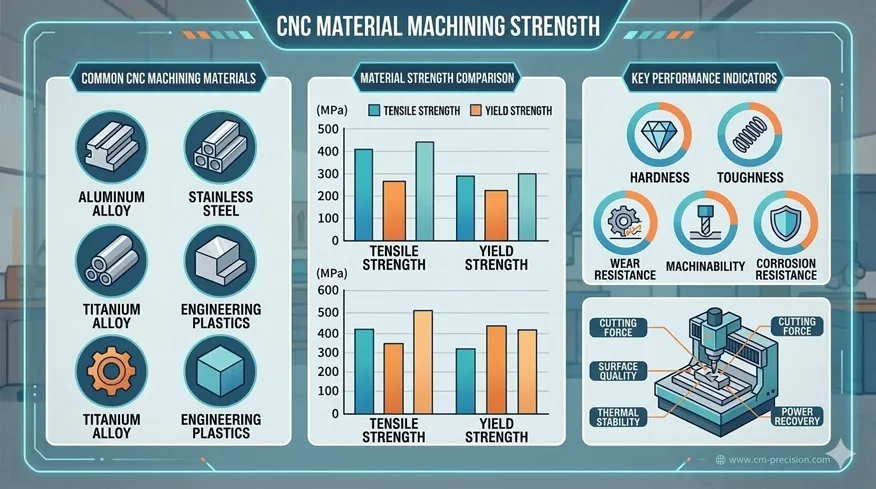
CNC machining starts with a solid block. This block has even grain and high density. The process cuts away material without melting it. The metal or plastic keeps its original properties. No extra pores or weak spots are made. The finished part is strong and reliable.
Here is a quick comparison of how cnc machining affects metals and plastics:
Aspect | Metals | Plastics |
|---|---|---|
Heat Generation | Makes a lot of heat, which can wear out tools | Makes less heat, but too much can bend the part |
Material Removal Rates | Slower because metals are hard, needs tough tools | Faster, but can get too hot |
Tool Wear | Tools wear out faster, so harder tools are needed | Tools last longer, but picking the right tool matters |
Surface Finish | Often needs extra steps to make smooth surfaces | Can be smooth right after machining |
Tolerance and Precision | Keeps tight tolerances because metals are stable | More changes, so tolerances can be harder to keep |
Coolants and Lubricants | Almost always needed to cool things down | Sometimes not needed, depends on the plastic |
Cutting Tools | Usually made from hard stuff like carbide | Often high-speed steel or carbide with coatings |
Tensile Strength and Fatigue Resistance
CNC machining makes parts with high tensile strength. The process does not weaken the material. For example, machined stainless steel can be 600–1000 MPa strong. Fatigue resistance is also high, especially with a smooth surface. This is why CNC machining is used for parts that must handle stress and repeated use.
Tensile strength for machined stainless steel: 600–1000 MPa
Fatigue resistance: High, especially with a smooth finish
Industries like aerospace and automotive use CNC machining for important parts.
Advantages of Subtractive Manufacturing for Material Integrity
Subtractive manufacturing, like CNC machining, keeps the material strong. You do not add layers or melt the material. Parts are durable and have fewer defects. You can get very tight tolerances, sometimes down to microns. This precision is hard for other methods to match.
Keeps material strong for durable parts
Makes high-quality surfaces without layer lines
Gets tight tolerances for exact specs
If you want to learn more about CNC machining, check out this CNC machined parts service page.
When you compare CNC machining, casting, and 3D printing, CNC machining is best for strength, precision, and material performance. It is a great choice for many manufacturing needs.
Casting Material Strength and Properties
Material Density and Internal Porosity
Casting means pouring liquid material into a mold. The material cools and becomes solid. Sometimes, small air bubbles get trapped inside. These bubbles are called porosity. Porosity can make the part weaker. It also makes the part less dependable. Sand casting usually has more porosity than other methods. Squeeze casting and investment casting help fix this problem. They make parts with fewer bubbles and higher density. These methods give you stronger parts. You need to talk with foundries about materials and designs. Working together helps you get better parts. Your parts will last longer and work well in real life.
Mechanical Strength of Cast Metals
Casting lets you make metal parts with tricky shapes. The strength of cast metals depends on the process and material. Cast parts can be strong, but not always the strongest. CNC machining and 3D printing can make even stronger parts. Cast metals often have lower tensile strength. Fatigue resistance is also important for cast parts. This means how well a part handles stress again and again. The casting process can change this property. To get better fatigue resistance, you must reduce defects. You also need to use better casting methods. Advanced casting can make parts stronger. This is good for things like engine blocks and turbine blades.
Casting Limitations for High-Performance Parts
Casting has some problems for high-performance parts. You might find defects like inclusions, shrinkage, or porosity. These problems can make the part weaker and less safe. You may need to check the parts more and do extra machining. Cast parts can have rough surfaces, especially with sand casting. You might need to grind or polish them to make them smooth. Casting also costs a lot at first because of molds and tools. This is not good for making just a few parts. The accuracy and surface finish can change with each casting method. You need to pick the right method for your needs.
3D Printing Material Strength and Properties
Layer Adhesion and Anisotropic Strength
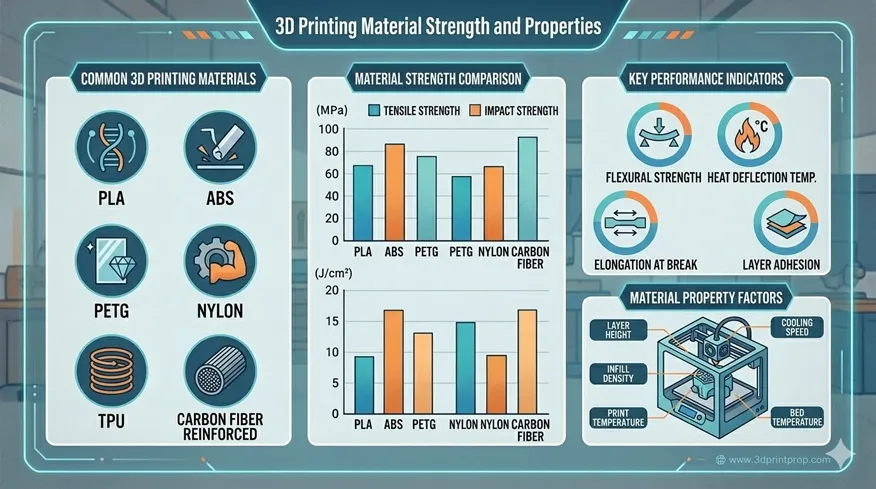
3d printing builds parts one layer at a time. Each layer sticks to the layer below it. This can cause weaker spots between layers. The strength between layers is not as high as inside a layer. The table shows how much weaker the layers can be:
Strength Type | Percentage of Strength |
|---|---|
Interlayer Adhesion | 30–50% weaker |
Intralayer Strength | 100% (baseline) |
Parts printed in different directions can be stronger or weaker. This is called anisotropic strength. To make the strongest part, line up the main forces with the layers.
Mechanical Properties of Additive Manufacturing Materials
3d printing uses many materials. The strength depends on the material, the printing process, and how you print. Post-processing steps also matter. Here is a table showing common materials and their uses:
Material Type | Properties | Applications |
|---|---|---|
Resins | High-resolution, smooth surfaces | Dental models, jewelry |
Metals | High strength-to-weight ratio, corrosion resistance | Aerospace, medical implants |
Polymers | Strength, durability, flexibility | Prototyping, end-use parts |
Composites | Enhanced strength and stiffness | Automotive, aerospace |
Ceramics | Hardness, high-temperature resistance | Wear-resistant components |
Wax | Detail and complexity in molds | Investment casting |
Sand | Complex geometries, quick turnaround | Metal casting |
3d printing lets you use many materials for different jobs. Metal 3d printed parts can be stronger and harder than old methods. But they may not last as long if used again and again.
Limitations of 3D Printed Structural Parts
3d printed parts can be strong if they are dense. If there are gaps or weak bonds, the part will not be as strong. The strength changes with the material, process, and how you print. Additive manufacturing gives you lots of choices. But you need to check if the part is right for your job. In the cnc machining vs casting vs 3d printing comparison, 3d printing is good for tricky shapes and quick changes. It may not always be as strong as other ways.
3d printing is best for prototypes and custom parts.
Use it when you want complex shapes or fast results.
For very strong parts, try other methods.
Tip: Always test your 3d printed parts before using them for important work.
CNC Machining vs Casting vs 3D Printing Material Strength Comparison
Tensile Strength Comparison
You want your parts to be strong. You also want them to last a long time. Tensile strength shows how much pulling force a part can take before it breaks. CNC machining gives the highest tensile strength. This is because you start with solid materials. Casting can make strong parts too. But small air pockets can lower the strength. 3d printing can make tough parts, especially with metals. But the layers can be weak spots. When you compare cnc machining, casting, and 3d printing, cnc machining is the strongest. Casting comes next. 3d printing is last for strength.
Fatigue Resistance Comparison
Fatigue resistance tells you how well a part handles repeated stress. You want your parts to work again and again without breaking. Here is what you should know:
CNC machining makes parts with high fatigue resistance. The solid structure helps parts last longer.
Casting can have lower fatigue resistance because of tiny defects inside the part.
3d printing can surprise you. For example, Johnson & Johnson made 3d printed hip joint cups from cobalt chromium alloy. These passed 10 cycles in tough fatigue tests, which is much better than the industry standard of 5 × 10 cycles.
Density and Porosity Differences
Density and porosity affect how strong and reliable your parts are. You want high density and low porosity for the best results. Here is a table that shows the differences:
Manufacturing Process | Porosity Level (%) | Density (%) |
|---|---|---|
CNC Machining | ~0 | 100 |
Metal 3D Printing | <0.5 | 99.5 |
Casting | 1-2 | 98 |
In metal 3d printing, you usually see porosity between 0.2 and 0.5 percent. You can lower this even more with heat treatment. SLM and DMLS 3d printing methods give you parts with even density in all directions.
Material Performance Comparison Table
You need to know which process works with which materials. Here is a quick guide:
Processing Method | Metal | Plastic | Composites | Elastic |
|---|---|---|---|---|
CNC Machining | Aluminum, Stainless Steel, Steel, Brass, Copper, Titanium, Bronze, Tool Steel, Tungsten | Acrylic (PMMA), Polyethylene (PE), Polypropylene (PP), PC, Nylon, Delrin (POM), PET, PVC, ABS, POM | GFRP, CFRP | / |
3D Printing | Stainless Steel, Titanium, Nickel Alloys | Thermoplastics, Photopolymer Resin | GFRP, CFRP | TUP, Silicone |
Casting | Aluminum, Steel, Iron, Bronze, Brass | Some Thermosets | GFRP | / |
You can use this table to pick the right process for your project. Each method has its own strengths for different materials and production needs.
Additive vs Subtractive Manufacturing Material Strength
Structural Integrity of Machined Parts
You want your parts to be strong when used. Machined parts are good for this. Subtractive manufacturing starts with a solid block. You cut away the extra material. This keeps the inside of the part even and dense. The outside of a machined part is smooth and clean. This helps stop damage from stress, rust, or wearing out. These parts last longer and work well in hard jobs. Machined parts do not have weak spots or hidden holes. You can trust them for important things.
Mechanical Performance of Additive Parts
3d printing makes parts one layer at a time. This way lets you make many shapes. Some shapes are hard to make with other ways. But there are some limits you should know. 3d printing can leave small gaps or weak spots between layers. These can make your part less strong. The way you print matters a lot. Some parts are strong in one direction but weak in another. The surface can feel rough and may need extra work to smooth it. Here is a table to help you compare:
Aspect | Additive Manufacturing (3d printing) | Subtractive Manufacturing (Machining) |
|---|---|---|
Surface Finish | Rough, needs post-processing | Smooth, tight tolerances |
Structural Integrity | May have pores and weak spots | High, no weak points |
Design Flexibility | Very high | Lower |
Material Properties | Can change with direction and defects | Strong and even |
Remember, 3d printed parts can get weaker if they have defects. These problems can make the part break more easily. Parts may not last long if used many times.
3d printing can make parts strong in one way but weak in others.
Weak spots or holes can make the part wear out faster.
Machined parts keep their shape and strength better.
When Subtractive Manufacturing Is Stronger
Pick subtractive manufacturing when you need the most strength and accuracy. Machined parts are best for good prototypes and making lots of parts. They give the smoothest finish and the best fit. Here is a quick look:
Aspect | Subtractive Manufacturing | Additive Manufacturing (3d printing) |
|---|---|---|
Precision | High | Moderate |
Mass Production | Strong | Weak |
Surface Finish | Superior | Inferior |
Machined parts are stronger and more exact than 3d printed parts.
Machining works better for metal parts.
Use subtractive methods for parts that must not break.
3d printing is good for cool shapes and fast changes. But for the strongest and most trusted parts, subtractive manufacturing is the best choice.
CNC Machining vs Casting vs 3D Printing Manufacturing Comparison
Cost Differences
You want to know how much each process costs. CNC machining costs more for tricky shapes. This is because it needs special tools and more machine time. 3d printing keeps costs steady, even for hard designs. You do not pay extra for complex parts. Casting costs a lot at first because you need molds. But it gets cheaper when you make many parts. If you need only a few parts, 3d printing usually saves money.
Production Lead Time
You care about how fast you get your parts. CNC machining can deliver parts in 2 to 5 days for small batches. 3d printing is even faster, often taking just 1 to 3 days. Casting takes the longest. You may wait 3 to 6 weeks for setup and tooling. After that, casting can make many parts quickly. For fast prototypes, 3d printing is the best choice. For big orders, casting works well after setup.
Design Complexity and Geometry Limitations
You can make very complex shapes with 3d printing. Internal channels and lattice structures are easy to create. CNC machining works best for simple shapes with tight tolerances. If you try to make a complex part with CNC machining, the cost goes up. Casting can make some complex shapes, but not as many as 3d printing. Here is a table to help you see the differences:
Manufacturing Method | Design Flexibility | Cost of Complexity | Internal Structures |
|---|---|---|---|
Metal 3D Printing | Exceptional, complex geometries possible | No extra cost for complexity | Easy, including cooling channels |
CNC Machining | Limited by tooling | Cost rises with complexity | Hard or impossible |
Tip: Use 3d printing for parts with undercuts, hollow spaces, or detailed features.
Manufacturing Comparison Matrix
You need a clear comparison to help you choose. This table shows how CNC machining, 3d printing, and casting stack up for speed, accuracy, and best use:
Feature | CNC Machining | 3D Printing | Die/Investment Casting |
|---|---|---|---|
Speed (1–10 pcs) | 2–5 days | 1–3 days | 3–6 weeks (tooling) |
Speed (100+ pcs) | 1–2 weeks | 1–2 weeks | 2–4 weeks (after tooling) |
Tolerance | ±0.01–0.05 mm | ±0.1–0.5 mm | ±0.1–0.5 mm |
Surface Finish | Ra 0.8–3.2 μm | Ra 6–12 μm | Ra 1.6–6.3 μm |
Best For | Functional prototypes, production parts | Complex shapes, lattice | High-volume, simple shapes |
You can use this comparison to pick the right manufacturing method for your project. 3d printing gives you speed and design freedom. CNC machining gives you accuracy and strong parts. Casting is best for high-volume production.
When to Choose CNC Machining
High Strength Structural Components
You need parts that can handle heavy loads and tough conditions. CNC machining gives you solid pieces with high strength. You start with a strong block of metal or plastic. The process removes material and keeps the inside dense. This makes your parts reliable for bridges, machines, and vehicles. You can trust these parts to last a long time. Engineers use cnc machining for airplane parts, car frames, and industrial tools. If you want your project to stand up to stress, choose this method.
Tip: Pick cnc machining when your part must not break or bend under pressure.
Precision Metal Parts
You want parts that fit together perfectly. CNC machining lets you make metal parts with tight tolerances. The machines cut with great accuracy. You can get parts that match your design exactly. This is important for gears, engine parts, and medical devices. You avoid mistakes and get smooth surfaces. You can also make small parts with fine details. If you need exact shapes and sizes, cnc machining is the best choice.
Get parts that fit together without gaps.
Make parts for robots, cars, and scientific tools.
Use this method for jobs that need high precision.
Low to Medium Production Volumes
You may not need thousands of parts. CNC machining works well for small and medium batches. You do not have to pay for expensive molds. You can change your design quickly. This saves money and time. You can test your parts before making more. Factories use cnc machining for prototypes and custom orders. If you want flexibility and fast results, this method fits your needs.
Production Volume | Best Method |
|---|---|
1–100 | CNC Machining |
100–1,000 | CNC Machining |
1,000+ | Casting or Printing |
Note: CNC machining gives you strong, precise parts without high setup costs.
When to Choose Casting
Large Metal Components
You should choose casting when you need to make large metal components. This process lets you create big parts without using a lot of material or machine time. You can pour molten metal into a mold and let it cool. This method works well for items like engine blocks, pump housings, and heavy machinery bases. You do not need to worry about the size limits of machines. Casting gives you strong parts that can handle heavy loads.
Note: If you want to save money on big projects, casting is a smart choice.
Complex Internal Shapes
Casting helps you make complex internal shapes that are hard to create with other methods. You can design parts with hollow spaces, curves, or channels inside. The mold forms every detail, so you do not need extra steps. This is useful for making complex parts like valves, manifolds, and turbine blades. You can get the shapes you want without drilling or assembling many pieces.
You can make parts with hidden passages.
You can reduce the number of joints or welds.
You can improve how your part works by shaping the inside.
High Volume Production
Casting is best for high volume production. Once you have a mold, you can make thousands of parts quickly. The cost per part goes down as you make more. Factories use casting to produce items like pipes, wheels, and hardware in large numbers. You can keep your production steady and meet big orders on time.
Benefit | Why Choose Casting? |
|---|---|
Low cost per part | Good for mass production |
Fast output | Make many parts at once |
Consistent quality | Each part matches the mold |
Tip: Use casting when you need lots of the same part and want to keep costs low.
When to Choose 3D Printing
Rapid Prototyping
You can use 3d printing when you need to test ideas quickly. This process helps you make models and parts in just a few hours. You do not have to wait for molds or special tools. 3d printing lets you see your design, touch it, and check if it works. Many engineers use 3d printing for rapid prototyping. You can change your design and print a new version the same day. This saves time and helps you fix problems early.
Tip: Use 3d printing to show your ideas to others before you start full production.
Complex Lightweight Structures
You can make shapes with 3d printing that are hard or impossible with other methods. 3d printing builds parts layer by layer. This means you can create hollow spaces, thin walls, and lattice patterns. These features make your parts lighter but still strong. For example, you can design a bike frame with less material but the same strength. 3d printing helps you use less metal or plastic, which saves money and weight.
Make parts with special shapes for cars, planes, or medical tools.
Create strong but light parts for sports equipment.
Try new designs that would cost too much with other methods.
3d printing is a type of additive manufacturing. You add material only where you need it.
Low Volume Custom Parts
You should choose 3d printing when you need just a few custom parts. You do not need to pay for expensive molds or wait for long setup times. 3d printing lets you make one part or a small batch with the same speed and cost. You can change the design for each part if you want. This is great for making dental crowns, hearing aids, or special machine parts. You can also use 3d printing for art, models, or gifts.
Use Case | Why Choose 3D Printing? |
|---|---|
Custom medical devices | Fast, fits each person |
Replacement machine parts | Quick, no need for old molds |
Art and models | Unique shapes, easy changes |
Note: 3d printing gives you freedom to make what you want, when you want it.
Manufacturing Process Selection Guide
Choosing the right process for your project can feel tricky. You want your parts to be strong, affordable, and ready on time. This guide helps you match your needs to the best method.
Strength Requirements
Start by thinking about how strong your part needs to be. If your part must handle heavy loads or stress, you should pick a process that gives high mechanical properties. CNC machining works well for parts that need top strength and toughness. Casting can also make strong parts, but you may find small weak spots inside. 3D printing is good for lighter loads or when you need special shapes. Always check the strength, ductility, and toughness of your chosen material.
Tip: For safety-critical parts, choose a process that gives the highest and most reliable strength.
Production Volume
Next, look at how many parts you need. If you only need a few, CNC machining or 3D printing can save you money and time. These methods do not need expensive molds or long setup. For large numbers, casting is often the best choice. Once you have a mold, you can make thousands of parts quickly and at a lower cost per part.
Small batches: CNC machining or 3D printing
Large batches: Casting
Cost and Lead Time Considerations
You also need to balance your budget and timeline. Each process has different costs and speeds. Use this table to compare the main factors:
Factor | Description |
|---|---|
Mechanical Properties | Check if the process gives the strength and toughness you need. |
Cost | Think about material, processing, and design costs. |
Machining Difficulty | Consider how hard it is to make your part based on shape, size, and quality needs. |
If you want fast results, 3D printing is often the quickest. For the lowest cost per part in big projects, casting is best. CNC machining gives a good balance for medium runs and high quality.
Note: Always match your manufacturing process to your project’s needs for the best results.
You have learned that CNC machining gives you the strongest and most precise parts. Casting works best for large or complex shapes in high volumes. 3D printing lets you create custom or lightweight designs quickly. To choose the right method, focus on your goals:
Define what your part must do for strength, cost, and speed.
Reduce design complexity for better results.
Use quality checks to improve safety and performance.
Decide if you should make or buy parts for the best value.
Always match your process to your project needs.
FAQ
What makes CNC machining parts stronger than cast or 3D printed parts?
You start with a solid block. The material stays dense and even. No pores or weak spots form. Machined parts keep their original strength.
Can you use 3D printing for high-strength metal parts?
You can print strong metal parts. Metal 3D printing works well for prototypes and custom shapes. Layer bonds may be weaker than solid metal. Always test your parts.
Is casting cheaper for large production runs?
Casting costs less per part when you make many. You pay more at first for molds. After setup, casting gives you fast and steady output.
Which process gives the best surface finish?
CNC machining gives you the smoothest finish. You get tight tolerances and clean surfaces. 3D printing and casting may need extra polishing.
How do you choose the right manufacturing method?
You look at your project needs. Think about strength, cost, speed, and design complexity. Use a table to compare:
Need | Best Method |
|---|---|
High strength | CNC Machining |
Complex shape | 3D Printing |
Large volume | Casting |