LKprototype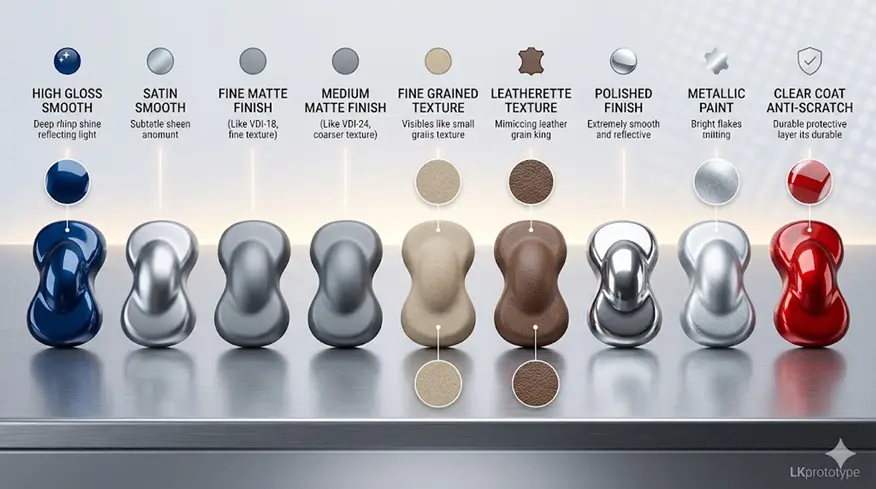
You should pick the best urethane casting surface finish for your project. Think about how you will use the part, how it looks, and what it needs to do. Engineers and designers often care about abrasion resistance, chemical compatibility, temperature range, UV stability, and if it meets food or medical rules. Think about your use, the look you want, and how well it should work. The right finish helps your part last longer and work better.
Key Takeaways
Pick the best urethane casting surface finish for your project. Think about how it looks, works, and how long it will last.
Matte, semi-gloss, and high-gloss finishes each have their own use. Choose one that makes your part look good and work well.
Getting ready is important. Clean and trim your parts the right way. This helps you get the best finish and stops problems.
Ask experts if you are not sure. They can give you good advice about which finish to use.
Always test a small group before making a lot. This makes sure the finish is what you want and need.
URETHANE CASTING SURFACE FINISH OVERVIEW
WHAT IS SURFACE FINISH
You might ask what surface finish means in urethane casting. It is how the outside of your part looks and feels. The finish can be shiny, smooth, rough, or soft. There are a few main types you can pick from in manufacturing. Each type makes your part look and feel different.
Finish Type | Description | Applications |
|---|---|---|
Matte/Frosted | Non-reflective, soft appearance with subtle texture. | Ideal for visual inspection and consumer products where a softer look is desired. |
Semi-Gloss | Smooth, slightly reflective surface that balances aesthetics and practicality. | Suitable for general-purpose prototypes and functional parts that are frequently handled. |
High-Gloss | Mirror-like sheen that highlights contours and features. | Used for display models and luxury consumer products where high-quality appearance is essential. |
Textured | Controlled surface roughness that improves grip and durability. | Ideal for components requiring tactile interaction, such as handles and grips. |
Each finish has its own job. You should choose the finish that fits your project best.
WHY SURFACE FINISH MATTERS IN URETHANE CASTING
You need to think about surface finish when using urethane casting. The finish is not just about looks. It also changes how your part works. For example, a rougher finish can make a part stronger.
The analysis of fracture surfaces reveals that a rougher fractured surface in nanocomposites corresponds to greater spall strength. This indicates that increased roughness is associated with a more energy dissipative failure mechanism, which directly impacts the mechanical properties of urethane cast parts.
This means the right finish helps your part last longer and stay strong.
IMPACT OF SURFACE FINISH ON AESTHETICS AND FUNCTION
You want your urethane casting to look nice and feel good. The finish you pick changes how your part looks and feels.
Surface Finish Type | Visual Appeal | Tactile Feel | Functional Benefits |
|---|---|---|---|
Glossy | Enhances visibility of fine details | Smooth feel | Suitable for intricate designs |
Textured | Adds controlled surface roughness | Improved grip | Reduces fingerprints, enhances durability |
Matte | Provides a modern look | Soft touch | Reduces light reflection, suitable for sensitive environments |
Studies show that people like products that feel good to touch.
Coatings help keep color even and make parts look and feel better, which helps in the market.
You should always think about how your part will look and feel to users.
TYPES OF URETHANE CASTING SURFACE FINISH
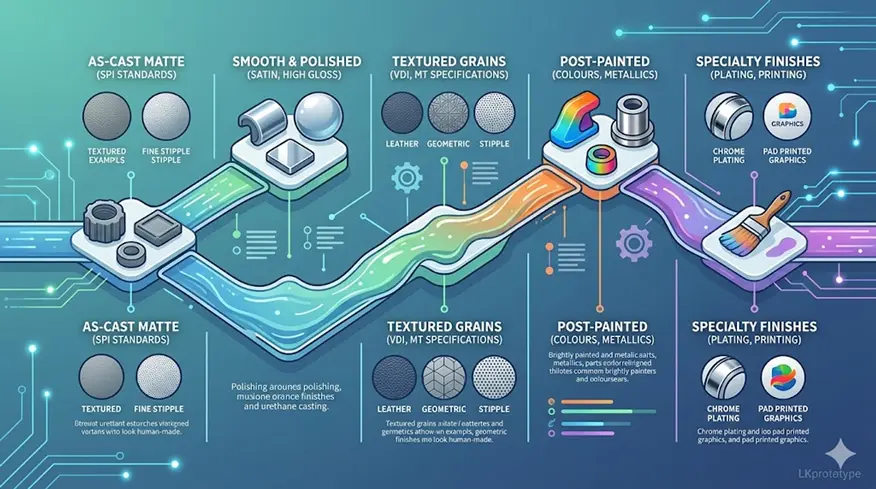
HIGH-GLOSS FINISH
A high-gloss finish makes your part look shiny and bright. It looks like a mirror and stands out a lot. This finish is good for parts that need to look smooth and new. Many fields use this finish, like:
Automotive
Aerospace
Medical Devices
Consumer Products
Industrial Equipment
You see this finish in quick prototypes and special product runs. It helps you make parts that look like real products but cost less.
SEMI-GLOSS FINISH
A semi-gloss finish gives your part a soft shine. It is not as bright as high-gloss. You can use it for many things, like:
Medical devices that are safe to use
Covers for electronics
Sports gear like wheels and grips
Small batches of car bumpers
Test models before making lots of parts
This finish looks nice and works well. It is simple to clean and does not show fingerprints as much.
SATIN FINISH
A satin finish is between matte and gloss. It gives a gentle shine and keeps away stains and water. Look at the table to see how it compares:
Finish Type | Scratch Resistance | Maintenance Requirements |
|---|---|---|
Matte | Low | Hardest to clean |
Satin | Medium | Easier to clean |
Gloss | High | Easiest to clean |
Satin finishes are good for busy places. They last longer than matte and are easier to keep clean.
MATTE FINISH
A matte or frosted finish does not reflect light. It hides scratches and gives a soft look. Use this finish if you want to stop glare. It is common in things people use every day and in places that need to be careful. Matte finish does not last as long and is harder to clean, but it looks modern.
TEXTURED AND CUSTOM FINISH OPTIONS
Pick a textured finish if you want better grip or a special style. Urethane casting lets you make many different textures. Here are some examples:
Surface Texture Type | Typical Use Case |
|---|---|
Custom Textures | Prototypes in many industries |
High Polish | Consumer electronics |
Detailed Architectural Models | Visualizations |
Ergonomic Handheld Devices | Comfort and usability |
Specialized Footwear | Athletic or medical applications |
Marine Components | Durability in harsh environments |
You can find textured finishes in cars, electronics, medical tools, building models, special shoes, and boat parts.
PREPARATION AND CUSTOMIZATION IN URETHANE CASTING
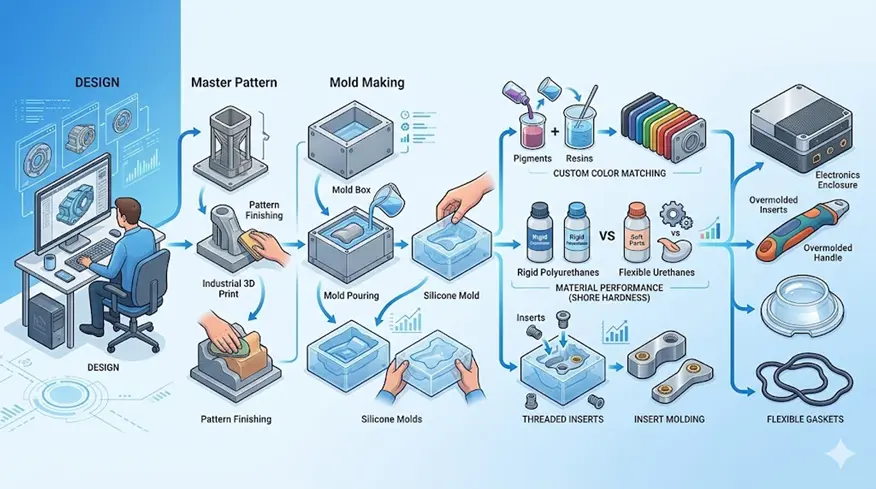
CLEANING AND TRIMMING METHODS
You need to prepare your urethane cast parts before finishing. Cleaning and trimming help you get a smooth surface. Follow these steps for best results:
Wipe the part with mineral spirits to remove dust, dirt, and wax.
Use a tack cloth to pick up fine dust after sanding.
Blow dust out of cracks with compressed air.
Scuff sand the surface using sanding blocks or sponges with 120 to 320 grit sandpaper.
Wet sand with 320 grit and a little water and detergent to smooth brush marks.
Avoid steel wool if you plan to use water-based polyurethane.
Make sure the part is dust-free before applying any finish.
These steps help you avoid defects and get a clean, ready surface.
CAST-IN COLOR AND TEXTURE
You can add color and texture during the casting process. This gives you more options for customization and helps your parts look good for a long time.
Customization Aspect | Description |
|---|---|
Color Options | Choose colors to match your brand or product style. |
Texture Options | Add custom textures for better grip and appearance. |
Finish Options | Pick finishes that boost durability and looks. |
Custom colors keep your brand identity strong.
Textures improve grip and make parts more attractive.
Durable finishes protect against wear and keep the part looking new.
When designing for urethane casting, you can use coatings like soft-touch paint or clear coats. These coatings protect the surface and keep the color safe, even if the part gets scratched.
PAINTING AND POST-PROCESSING OPTIONS
Painting and post-processing let you change the look and feel of your parts after casting. You can choose cast-in colors or paint after casting. Each method has pros and cons.
Method | Pros | Cons |
|---|---|---|
Cast-in colors | No chipping or peeling, keeps texture, lasts longer | Depends on master pattern, color may not be exact |
Painted after casting | Many colors, glossy look, hides lines, great UV stability | Can scratch, needs more labor, costs more |
To get the best finish, mix resin and hardener carefully, clean the part, sand for better paint grip, and use primer and thin coats of paint.
VACUUM CASTING SURFACE FINISHES
Vacuum casting uses a vacuum to pull resin into every part of the mold. This process removes air bubbles and gives you a smoother, more uniform surface. You get fewer defects and better texture. When designing for urethane casting, vacuum casting helps you achieve high-quality finishes with surface roughness as low as Ra 0.8μm. Standard casting may leave bubbles and rough spots, so vacuum casting is a smart choice for top appearance and texture.
CHOOSING THE RIGHT URETHANE CASTING SURFACE FINISH
KEY FACTORS TO CONSIDER
You should think about a few things before picking a urethane casting surface finish. First, ask what your part or prototype will do. Do you want it to look shiny, feel smooth, or have a special grip? The finish you pick changes how good your part is and how well it works. You also need to think about cleaning the part and if it needs to follow safety rules. Always choose a finish that fits your project for the best results.
AESTHETICS, FUNCTION, AND GRIP
How your prototype looks and feels is very important. If you want your part to shine and stand out, use a glossy finish. If people will touch the part a lot, a textured urethane casting surface finish is better. Custom textures help people hold the part and make it easier to use. For example, medical device housings use smooth finishes so they are easy to clean, but textured finishes give better grip and make them safer to hold. Always think about how the finish changes both the look and the use of your prototype.
DURABILITY AND COST CONSIDERATIONS
You want your prototype to last a long time. The right urethane casting surface finish can make it stronger and harder to wear out. Polishing the surface helps your part last longer by stopping friction and wear. This is important for prototypes that need to work well for a long time. Some finishes take more time and work, so they can cost more money. You should think about how much you want to spend and how good you want your part to be.
PRODUCTION VOLUME IMPACT
How many parts you make changes what urethane casting surface finish you can use. Urethane casting is best for making a small number of parts because it costs less to start and is faster. This is good for prototypes or small batches. When you make more parts, each one costs less, but if you need a lot, other ways like injection molding are cheaper. Silicone molds used in urethane casting wear out faster, so you might need new ones for big jobs. Always pick a finish that matches how many parts you need for the best quality and price.
COMPARISON TABLE AND CHECKLIST
SURFACE FINISH COMPARISON TABLE
You can compare different surface finishes by looking at key parameters. These measurements help you understand how smooth or rough your part will feel. Here is a table that explains the most important parameters:
Parameter | Description |
|---|---|
Ra | Average roughness. It shows how much the surface goes up and down. |
Rmax | Maximum roughness depth. It measures the tallest peak to the deepest valley. |
Rz | Average maximum height. It uses the five biggest differences on the surface. |
RMS | Root Mean Square. It is another way to measure how rough the surface is. |
CLA | Center Line Average. It is a special type of average for surface finish. |
Cut-Off Length | The length used to check the surface finish. |
N | ISO grade number. It tells you the quality level of the finish. |
You can use these numbers to pick the right finish for your project.
QUICK SELECTION CHECKLIST
You can use this checklist to help you choose the best urethane casting surface finish:
Decide if you want a shiny, satin, matte, or textured look.
Think about how people will use or touch the part.
Check if the part needs to be easy to clean.
Make sure the finish matches your brand or product style.
Ask if the finish will last as long as you need.
See if the finish fits your budget.
Count how many parts you need to make.
Ask your supplier for samples if you are not sure.
Tip: Always test a small batch before making many parts. This helps you avoid surprises.
TIPS TO AVOID COMMON SURFACE DEFECTS
You can prevent most surface defects by following good practices. Here is a table with common problems and how to stop them:
Defect Type | Description | How to Prevent |
|---|---|---|
Porosity | Small holes or air pockets. They make the part weak. | Vent the mold well. Pour slowly. Keep the mold clean. |
Shrinkage | Empty spaces from cooling. | Use risers. Cool the part evenly. Add insulation. |
Cold shuts | Weak seams from poor flow. | Keep the resin hot. Make sure the mold fills smoothly. |
Misruns | Mold does not fill all the way. | Pour at the right temperature. Preheat the mold. |
Inclusions | Dirt or particles inside the part. | Clean everything before pouring. Filter the resin. |
Hot tears | Cracks from uneven cooling. | Use flexible molds. Cool the part slowly and evenly. |
Note: Clean tools and careful pouring help you get the best finish every time.
CONSULTING URETHANE CASTING EXPERTS
WHEN TO SEEK ADVICE
You might not know when to talk to a urethane casting expert. Experts can help you pick the right surface finish. You should ask for help if your project is special or you want the best part. The table below shows when you need expert advice most:
Scenario | Relevance to Surface Finish Selection |
|---|---|
Functional Prototypes | Critical for ensuring the prototype meets performance requirements. |
Cosmetic Validation | Important for achieving the desired aesthetic quality in the final product. |
Specific Material Properties | Necessary to meet performance specifications and functional needs. |
If you want your prototype to work well, look nice, or follow strict rules, talk to an expert. Experts know how to choose finishes that fit your needs.
QUESTIONS TO ASK SUPPLIERS
You should ask clear questions when you talk to suppliers. This helps you get the finish you want for your part. Here are some questions you can use:
What surface finishes do you offer for urethane casting?
Can you show samples of each finish?
How does the finish affect durability and cleaning?
What is the best finish for my part’s use?
How long will the finish last?
Are there special finishes for medical or food-safe parts?
What is the cost difference between finishes?
Tip: Always ask for samples before you order a lot. Samples let you see and touch the finish.
BEST PRACTICES FOR QUALITY FINISH
You can follow easy steps to get a good surface finish. Experts say these are the best ways:
Use dowel pins to keep through-holes safe when making molds
Make part shapes simple to lower mold cost and make it easier
Add draft angles of 2° to 5° so parts come out of molds easily
Keep wall thickness the same for even curing and a smooth finish
You get better results when you use these tips. Your parts look better and last longer. Experts can help you do these steps and avoid problems.
You should always match your urethane casting surface finish to your project’s needs. The right finish depends on how you plan to use the part, how you want it to look, and what it must do. Use the comparison table and checklist to help you make quick choices. For complex projects, you can:
Get design and engineering support.
Ask for CAD reviews and design consultations.
Use material datasheets from trusted manufacturers.
Expert advice helps you get the best results and meet high standards.
FAQ
What is the main benefit of choosing a specific urethane surface finish?
Picking the right urethane surface finish helps your part work better. It also makes your part look nicer and feel good to touch. The finish can help your part last longer too.
How do I know which urethane surface finish is best for my project?
Think about how you will use your part. Do you want it smooth or with texture? Do you need it easy to clean or want more grip? You can ask for samples to help you decide.
Can I use urethane casting for low-volume production?
Yes, you can use urethane casting to make a small number of parts. This way, you get good surface finishes and can try out different designs before making a lot.
Does the surface finish affect the durability of urethane parts?
The surface finish can change how tough your urethane part is. A smooth finish can stop scratches and wear. A textured finish can help you hold the part and hide small marks.
What steps help prevent surface defects in urethane casting?
Clean your mold and tools before you start. Pour the urethane slowly so you do not get bubbles. Use the right resin temperature. These steps help you get a smooth part every time.