LKprototype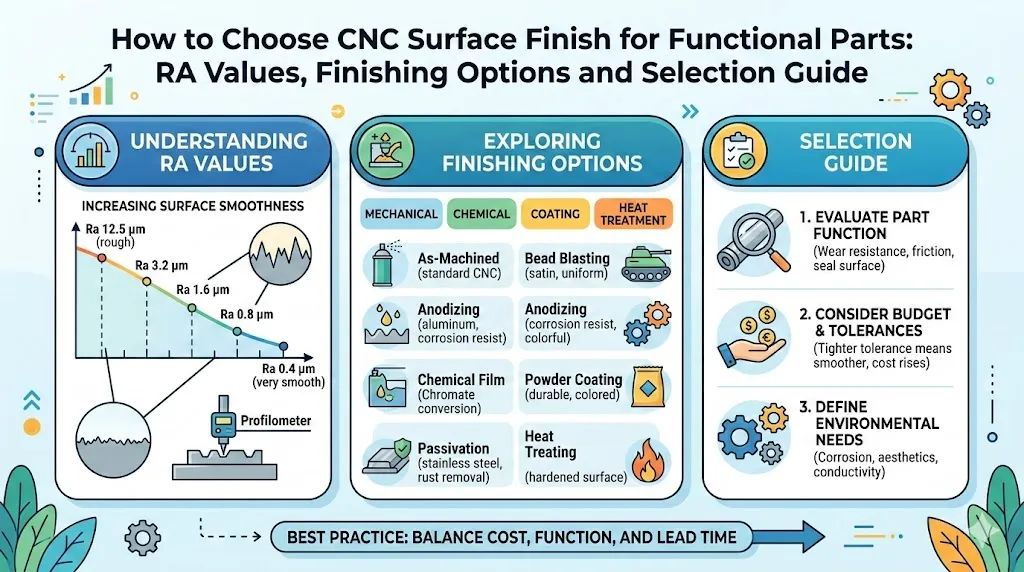
When you ask how to choose CNC surface finish for parts, you should consider how well the parts function and their overall quality. The right CNC finish can reduce friction, minimize wear, and extend the lifespan of the components. If you aim for the best quality, it's essential to understand how to choose CNC surface finish that meets your specific requirements. Smoother CNC surfaces facilitate better fitting of parts and prevent leaks or misalignment. Conversely, rough CNC surfaces can lead to rapid wear and even failure of the components. You enhance the performance and durability of parts when you know how to choose CNC surface finish for your application.
Key Takeaways
Learn about Ra values to pick the best surface finish. Lower Ra values make surfaces smoother. Smoother surfaces help parts work better and last longer.
Pick a finish that fits what the part does. Think about how much wear the part will get. Also, think about if it needs to seal well or look nice. This helps the part work its best.
Choose a surface finish that matches the material. Each material needs a certain finish for good results. For example, aluminum often uses anodizing.
Remember to think about cost and how many parts you need. Simple finishes usually cost less and are faster to make. More complex finishes can cost more and take longer.
Do not ask for very low Ra values unless needed. Only choose smoother finishes if you really need them. This helps save time and money when making parts.
What Is Surface Roughness in CNC Machining
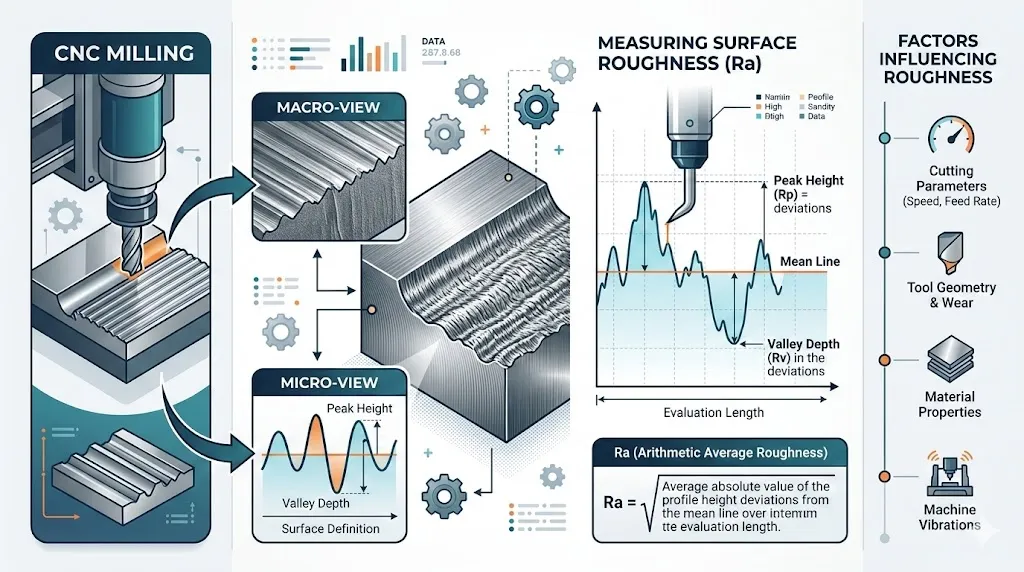
When you look at a cnc part, it might look smooth or rough. Surface roughness means there are tiny bumps and dips on the part. These small marks come from the cutting tool and how the machine moves. Sometimes you cannot see them, but they still matter for how the part works.
People use special numbers to measure surface roughness. The most used number is Ra. Ra is the average of all the little ups and downs on the surface. You add up the heights and take the average to get Ra. There are other numbers like Rz and Rt that also help explain the surface. Here is a table that shows what these numbers mean:
Parameter | Description |
|---|---|
Ra | The arithmetic average of absolute values of surface height deviations. |
Rz | The average distance between the highest peak and the lowest valley in a sample area. |
Rt | The vertical distance between the highest peak and the lowest valley in a single assessment length. |
There are different tools to check surface roughness in cnc. Some tools touch the part, and some use light or lasers. Here are some ways people measure it:
Contact profilometers have a diamond tip that moves across the part and feels the bumps.
Non-contact profilometers use lasers or light to look at the surface without touching it.
Atomic force microscopy can check very smooth surfaces with great detail.
3D scanning makes a map of the surface to show all the small details.
Surface roughness matters in cnc because it changes how parts fit, move, and last. You need to pick the right surface finish so your parts work well when used.
Understanding Ra Values and Surface Roughness Chart
What Is Ra Value
You often see Ra value when you look at cnc machined parts. Ra stands for Roughness Average. This number tells you how smooth or rough a surface feels. Ra measures the average height of tiny bumps and dips on the part. A lower Ra value means a smoother surface. A higher Ra value means the surface feels rougher. When you choose the right Ra value, you help your cnc machined parts work better and last longer.
A lower Ra value leads to improved surface smoothness.
A higher Ra value can negatively affect the performance and longevity of machined components.
How Ra Is Measured in CNC Machining
You can measure Ra in cnc using special tools. These tools check the surface and give you a number. The main things that affect Ra are:
The CNC machine used.
The machining parameters applied.
The type of material being machined.
You might use a contact profilometer, which drags a diamond tip across the part. You can also use non-contact tools like lasers. These methods help you check if your cnc machined parts meet your needs.
Typical Ra Values for Machined Parts
Different industries need different Ra values for their cnc machined parts. Here is a table that shows common Ra values:
Application/Industry | Typical Ra Value (μm) |
|---|---|
Rough machining | 3.2-6.3 |
Standard finish | 1.6-3.2 |
Fine finish | 0.8-1.6 |
Very fine finish | 0.4-0.8 |
Automotive | 1.6-3.2 |
Aerospace | 0.8-1.6 |
Medical | 0.4-0.8 |
General Manufacturing | 3.2-6.3 |
You should check this chart when you pick a finish for your cnc machined parts.
Ra 1.6 vs 3.2 Comparison
You may wonder how Ra 1.6 and Ra 3.2 compare. Ra 1.6 gives you a smoother surface than Ra 3.2. This difference can change how your cnc machined parts perform and how much they cost. Here is a quick comparison:
Surface Finish | Functional Performance | Cost Implications |
|---|---|---|
Ra 1.6 | Adequate for most mechanical applications | More cost-effective due to lower machining time |
Ra 3.2 | Suitable for non-critical surfaces | Higher cost due to increased machining complexity |
Tip: Choose Ra 1.6 for parts that need smooth movement or tight seals. Use Ra 3.2 for parts where surface finish is less important.
Why Surface Roughness Matters for Functional Parts
Surface roughness is important for how cnc parts work. You need to think about surface finish because it changes how parts fit and last. The right finish helps parts fit together well. It also makes them last longer and look nicer.
Surface Finish for Sealing Surfaces
Sealing areas need a smooth surface. If the surface is rough, fluids or gases can leak out. A good finish helps seals work well and keeps things tight. The table below shows how roughness levels change sealing:
Surface Roughness Level | Application | Effect |
|---|---|---|
Ra 0.4 µm | Dynamic Seals | Prevent fluid leakage |
You should always check the finish for sealing surfaces. This helps you get the best performance.
Surface Finish for Bearing and Sliding Components
Bearings and sliding parts need to be smooth. If the surface is rough, friction goes up and parts wear out fast. A smooth finish lets parts move easily and keeps them cool. It also lowers the chance of parts getting stuck. Here are some reasons why roughness matters for these parts:
Smooth surfaces help parts fit together right.
Smoother finishes lower friction and make parts last longer.
Rough surfaces can hold dirt and cause damage.
Surface Finish for Wear Resistance
You can make parts last longer with the right finish. A smooth surface lowers contact resistance. This means cnc parts do not break down fast. If there are tiny bumps, they can cause stress and cracks. You should match the finish to the part’s job for better strength.
Surface Finish for Cosmetic Appearance
You may want cnc parts to look nice as well as work well. A good finish gives parts a clean and pro look. How a part looks matters if people see or touch it. A smooth finish also helps coatings stick and keeps dirt away. Pick the right finish for both looks and use.
Tip: Always think about both looks and how parts work when you pick a finish for your cnc parts.
CNC Machining Surface Finish Options
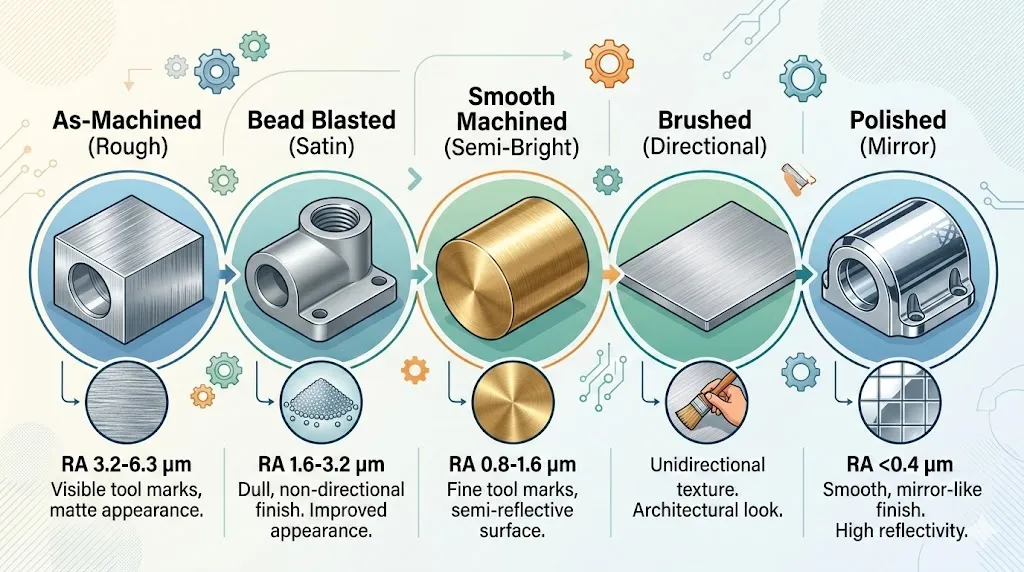
You can pick from many cnc surface finishes. Each finish makes your parts look and act different. These finishing choices help your parts work better and last longer. Here is a table that lists some top finishes for cnc parts:
Surface Finish Option | Characteristics | Advantages |
|---|---|---|
Polished | High quality, smooth surface | Makes parts look fancy and precise |
Spray Paint | Saves money | Good for making lots of parts |
Anodising | Makes parts thicker and harder | Helps aluminum parts last longer |
Powder Coating | Easy to put on, strong | Used a lot for metal parts |
High Polish | Needs many steps | Makes the surface very smooth |
If you want to know more about cnc surface finishing, you can check the CNC machined parts service page.
As Machined Finish
An as machined finish is what you get right after cnc. You do not need to do anything extra. The surface might have small tool marks. This finish is fine for parts that do not need to look perfect. As machined is quick and does not cost much. It is good for test parts and inside pieces.
Bead Blasting
Bead blasting uses tiny glass beads to finish parts. The beads hit the part and make it smooth and not shiny. This finish hides tool marks and makes the surface even. You can use bead blasting for looks and feel. It is great for parts that need to look clean.
Anodizing (Type II & III)
Anodizing is for aluminum parts. You use electricity and chemicals to make a hard layer on the part. Type II anodizing adds color and basic safety. Type III makes a thicker, harder layer for better wear. Anodizing helps parts last longer and stops rust. Pick this finish if you want strong parts with color.
Powder Coating
Powder coating covers parts with colored powder. You heat the part so the powder melts and sticks. This finish makes a tough, even layer. Powder coating keeps parts safe from scratches and rust. Use it for metal parts that need to be strong and colorful. It is a top finish for outdoor or busy parts.
Polishing and Brushing
Polishing and brushing make parts smooth and shiny. Polishing uses fine tools to take away tiny bumps. Brushing gives lines and a soft shine. These finishes make parts look and feel nice. Use them for parts people see or touch a lot. Polishing and brushing are great for fancy products.
Note: Finishing can help stop rust and wear. It also changes how your parts look and feel. Always pick the finish that fits your part’s job.
Pros and Cons of Different CNC Finishing Options
Cost Comparison of CNC Surface Finishes
You should think about cost when picking a finish for your CNC parts. Some finishes are more expensive because they need extra steps or special stuff. The table below shows how much common finishes cost:
Finishing Option | Cost Level |
|---|---|
Anodizing | $$$ (Type II); $$$$ (Type III) |
Bead Blasting | $$$ |
Powder Coating | $$ |
Powder coating is usually cheaper than anodizing or bead blasting. Type III anodizing costs the most because it makes parts tougher. You can save money if you pick a finish that fits your part’s job and do not ask for more than you need.
Durability and Corrosion Resistance
Durability and corrosion resistance are important for parts used in hard places. You want a finish that keeps your parts safe and working longer. The table below compares how strong and rust-proof each finish is:
Surface Finish Type | Durability | Corrosion Resistance |
|---|---|---|
Electropolishing | High | Excellent |
Mechanical Polishing | Medium | Good |
Standard Finish | Low | Poor |
Electropolishing gives the best protection. It makes the surface smooth and stops water from causing rust. Mechanical polishing helps parts last longer but does not protect as well as electropolishing. Standard finishes do not protect much. Pick a finish based on how much wear and water your parts will see.
Electropolishing makes parts resist rust by smoothing them.
If a surface is rough, it can hold water and rust faster.
Mechanical polishing after machining helps parts last longer.
Impact on Dimensional Tolerances
Precision is very important in CNC machining. The finish you pick changes how well your parts fit and work. Smoother finishes help parts last longer and move better. Good finishing also helps parts fit together tightly and stops leaks or weak spots.
Surface finish matters for both size and looks, which are important for quality.
Smoother finishes make parts stronger and lower friction, so they last longer.
Good finishes help parts fit together and stop leaks or weak spots.
Harder materials can get smoother finishes than soft ones.
Sharp tools make smoother surfaces, but dull tools make them rough.
The cutting fluid you use changes the surface. Some fluids work better for some materials and stop burn marks.
To get the finish you want, you must control things like material, tool sharpness, cutting fluid, feed rate, and cut depth.
Slower feed rates make smoother surfaces but take more time. Shallow cuts help keep tools cool and straight.
Tip: Always pick a finish that matches how exact your part needs to be. If you need tight fits, choose a finish that helps you get high accuracy.
How to Choose CNC Surface Finish Based on Application
Assess Functional Requirements
You should start by thinking about what your part needs to do. Ask yourself if the part must resist wear, stop corrosion, or look a certain way. Some parts need to handle harsh chemicals or high heat. Others need to match a color or texture. You can use this table to help you decide what matters most for your part:
Criteria | Description |
|---|---|
Functional Requirements | Does the part need wear or corrosion resistance? |
Material Compatibility | Is the finish right for your material? |
End-Use Environment | Will the part face chemicals, humidity, or heat? |
Aesthetic Requirements | Does the part need a special color or texture? |
Cost and Lead Time | Will the finish add cost or slow down production? |
Tip: Write down your main needs before you pick a finish.
Match Ra Value to Performance Needs
You should match the Ra value to how the part will be used. A smoother surface lowers wear and keeps dirt away. This helps stop corrosion and makes parts last longer. If your part moves against another part, a low Ra value is best. If your part faces tough conditions, a smooth finish can stop pitting and rust. Always check if your part needs a fine or rough surface.
Select Finish Based on Material Type
Not every finish works on every material. For example, anodizing works best on aluminum. Stainless steel and plastics need different finishes. You can use this table to see what Ra values fit common materials:
Application Type | Recommended Ra Range (μm) | Material | Achievable Ra Range (μm) |
|---|---|---|---|
Rough machining | 3.2-6.3 | Aluminum 6061 | 0.4-0.8 |
Standard finish | 1.6-3.2 | Carbon Steel | 0.8-1.6 |
Fine finish | 0.8-1.6 | Stainless Steel 304 | 0.8-1.6 |
Very fine finish | 0.4-0.8 | Plastics | 1.6-3.2 |
Note: Always check if your surface finishing choice matches your material.
Consider Budget and Production Volume
You should think about how many parts you need and how much you want to spend. Simple finishes like "as machined" cost less and work well for many parts. If you need many parts, a complex finish can raise costs and slow down production. High-performance finishes protect parts better but cost more. Use this list to help you decide:
Pick cost-effective finishes for large batches.
Choose advanced finishes for parts that need extra protection.
Remember that some finishes add thickness and can change part size.
Think about your budget and how many parts you need before you choose a finish.
Common Surface Finish Specification Mistakes
When you pick a finish for CNC parts, you can make mistakes. These mistakes can make parts cost more, work worse, or take longer to make. If you know about these mistakes, you can avoid them. This helps you choose the best surface finish for your part.
Over-Specifying Low Ra Values
You might think smoother always means better. But asking for very low Ra values can cause problems. Lower Ra values need more machining time. For example, changing from Ra 3.2 to Ra 1.6 takes 50% more time. Going from Ra 1.6 to Ra 0.8 doubles the time. Dropping from Ra 0.8 to Ra 0.4 adds 150% more time.
Ra Value Change | Increase in Machining Time |
|---|---|
Ra 3.2 to Ra 1.6 | +50% |
Ra 1.6 to Ra 0.8 | +100% |
Ra 0.8 to Ra 0.4 | +150% |
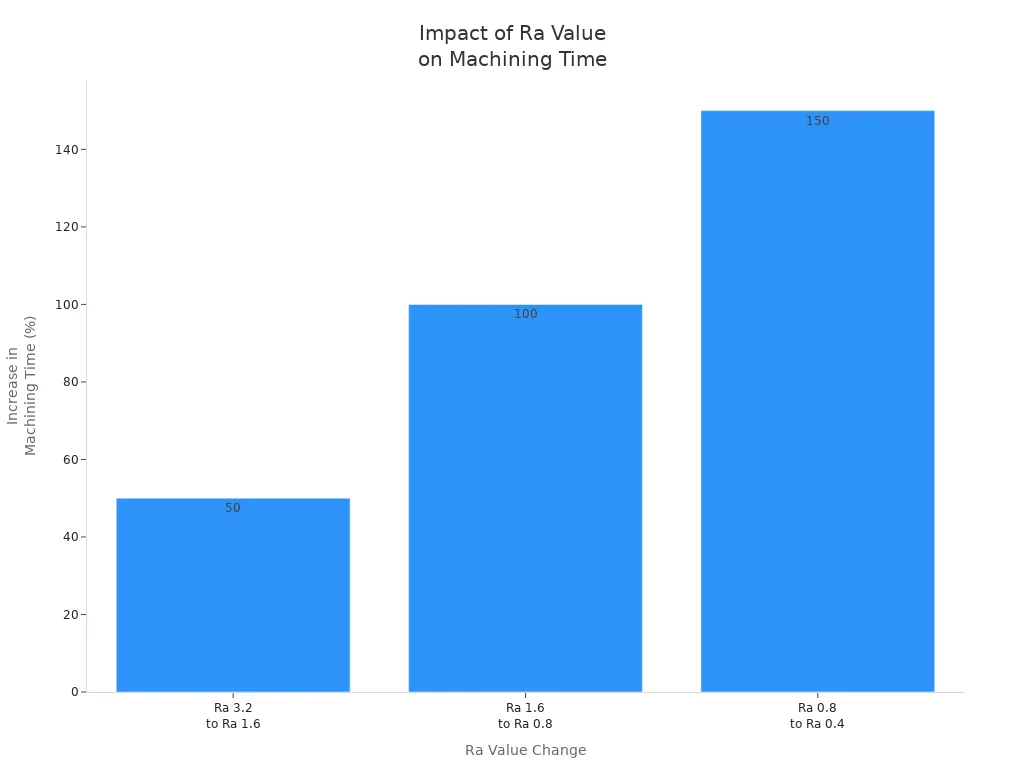
You should only ask for a low Ra value if your part really needs it. Picking a finish that is too smooth costs more and takes longer. Many engineers make this mistake because they do not check what the part really needs.
Tip: Use Ra 3.2 µm unless your part must be smoother for its job.
Ignoring Functional Requirements
You need to think about how the part will be used. If you forget about this, you might waste money and time. Picking the wrong finish can make parts cost more and slow down making them. Extra tool wear and extra steps may not help the part work better.
Always check if the finish helps the part do its job.
Different jobs need different surface finishes.
Match your finish to what the part does and where it will be used.
Confusing Cosmetic Finish with Functional Finish
You may want your parts to look nice, but looks are not always the same as function. Picking a finish just for looks can hurt how the part works. Some finishes make parts look shiny but do not help with wear or rust.
Cosmetic finishes make parts look clean and bright.
Functional finishes protect parts from wear, rubbing, and rust.
Make sure you know if your part needs a finish for looks or for how it works.
Note: The right surface finish depends on both how the part looks and how it works. Always balance looks and function when you pick a finish.
CNC Surface Finish Selection Checklist
When you want the best results from CNC machining, you need a clear checklist for surface finishing. This helps you avoid mistakes and get the right finish for your parts. Use this checklist to guide your choices:
Define Primary Functional Goals
Start by writing down what your part must do. Ask yourself if the part needs to resist wear, reduce friction, or stop corrosion. Think about the environment where the part will work. For example, a part in a wet place may need a finish that stops rust. If your part moves against another part, you may need a smoother surface finish. Always match the finish to the job.
Tip: Talk to experts if you are not sure about the best finish for your part.
Confirm Ra Value in Engineering Drawings
Check your engineering drawings for the correct Ra value. The Ra value tells you how smooth or rough the surface should be. Make sure the Ra value fits the part’s function. Use tools like profilometers or microscopes to measure the surface finish. If you need a very smooth finish, you may need to adjust the machining process. Always confirm the Ra value before you start production.
Use profile analysis to check the finish.
Inspect the surface under a microscope for tiny marks.
Verify Cost and Lead Time Impact
The finish you choose can change how much your project costs and how long it takes. A rougher finish is faster and cheaper. A mirror-like finish takes more time and money because it needs extra steps like polishing. Use the table below to compare finishes:
Finish Type | Typical Ra (µm) | Cost Impact | Best Use |
|---|---|---|---|
Rough Machined | 3.2–6.3 | Low | Prototypes, non-critical parts |
Standard Machined | 1.6–3.2 | Moderate | Most functional parts |
Polished | 0.8–1.6 | High | Visible or sliding surfaces |
Note: Only ask for a high-quality finish where it matters. This saves time and money.
By following this checklist, you can pick the right surface finishing for your CNC parts. You will get better quality and avoid common problems.
You can pick the best surface finish for your parts by following some easy steps. First, think about what your part must do and choose a finish that matches. Look at the table below to see how each finish helps your part:
Key Aspect | Description |
|---|---|
Corrosion Resistance | Changing the finish can help stop rust. |
Friction Reduction | The right finish makes moving parts slide better. |
Sealing Capabilities | A good finish helps parts seal tightly. |
Aesthetic Improvement | Finishing takes away marks and makes parts look nicer. |
Wear Resistance | The right finish keeps parts from wearing out fast. |
Surface Characteristics | Finishes control bumps and waves for better quality. |
You should always check the rules for your industry. Some fields, like aerospace and medical, need special finishes to keep people safe. If you are not sure what to pick, ask CNC experts for help. They know which finish works best for your material and how you will use it. The chart below shows normal Ra values for different finishes:
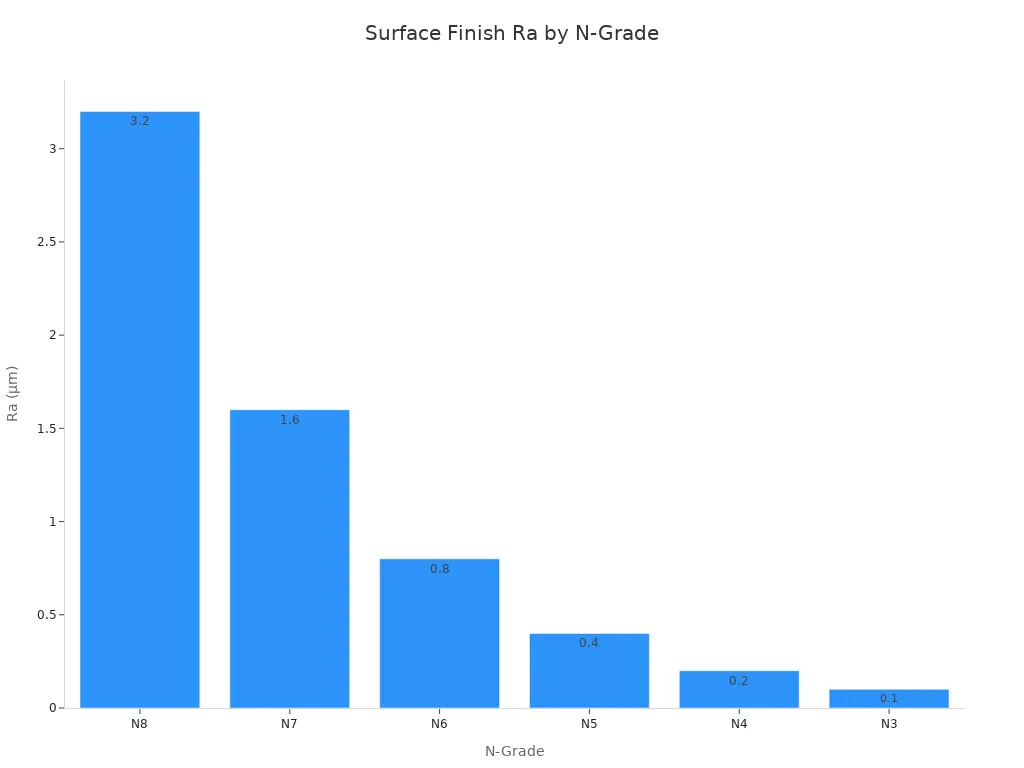
Start by writing down your part’s main job. Check the Ra value on your drawings. Think about how the finish will change the cost and how long it takes to make. Use this guide to help you make good choices and get the best CNC parts.
FAQ
What does Ra value mean in CNC surface finishing?
Ra value shows how smooth or rough a surface is. You use it to measure the average height of tiny bumps. Lower Ra means a smoother part. Higher Ra means a rougher part.
How do you choose the right surface finish for a CNC part?
You start by looking at what your part needs to do. Think about wear, corrosion, and appearance. Match the Ra value to your part’s job. Pick a finish that fits your material and budget.
Does surface finish affect part strength?
Yes, surface finish can change how strong your part is. Smoother surfaces help prevent cracks and wear. Rough surfaces may cause stress points and make parts break faster.
Can you use anodizing on all metals?
No, you cannot use anodizing on every metal. Anodizing works best on aluminum. Other metals like steel or copper need different finishes.
Why do some parts need a cosmetic finish?
Cosmetic finishes make parts look clean and shiny. You use them when people see or touch the part. These finishes also help coatings stick and keep dirt away.