LKprototype
Urethane casting color matching is achieved by precisely mixing pigments into polyurethane resin and aligning with Pantone or RAL standards to ensure consistent and accurate colors for prototype and low-volume production parts.
You get urethane casting color matching by mixing pigments into urethane resin. This lets you control how your products look. Mixing pigments carefully helps keep your brand the same and your products good. Urethane lets you make many colors. Surveys show matching colors can be hard. You can fix these problems by following clear steps, using set standards, and doing things the best way.
Key Takeaways
Getting the color right is very important. It helps keep the brand the same and makes customers trust you. Always look at samples in different lights to make sure the color is correct.
Use a simple process for color matching. Pick the right pigments, mix them well, and test samples before making a lot. This helps stop mistakes from happening.
Write down details for every batch. Include what pigments you use and how you mix them. This helps find problems and keeps the color the same over time.
Talk clearly with suppliers. Tell them what color you want and check samples. This makes sure the final product is what you expect.
Keep your workspace steady. Make sure the temperature and humidity do not change. This stops the color from changing and gives good results.
URETHANE CASTING COLOR MATCHING OVERVIEW
WHAT IS URETHANE CASTING COLOR MATCHING
Urethane casting color matching helps parts look the same each time. This process lets you get the right color before making lots of products. In factories, keeping colors the same is important for brands. Here is what urethane casting color matching does:
You get the same color before making many items.
You keep your brand strong by using the same colors.
You make it easy for customers to spot your products.
WHY ACCURATE COLOR MATCHING MATTERS
Getting colors right makes your products look neat and professional. Customers trust you more when your parts match your brand colors. If you use urethane for samples or finished items, you want every batch to look alike. Keeping colors the same stops confusion and mistakes. Accurate color matching also helps you follow industry rules. You show clients that you care about good quality.
Tip: Always check your samples in different lights. Colors can change in sunlight or inside.
COMMON CHALLENGES IN COLOR MATCHING
Matching colors in urethane casting can be hard. Sometimes pigments do not mix well. You might see lines or spots in your parts. Changes in temperature can affect how urethane dries and how the color looks. Different batches of urethane resin may react to pigments in new ways. Here is a table with common problems and ways to fix them:
Challenge | Solution |
|---|---|
Pigment not mixing | Mix longer and use tools |
Color shifts after curing | Test samples before full run |
Batch differences | Track resin lots and keep records |
You can fix these problems by following steps and checking your work often.
HOW TO ACHIEVE COLOR MATCHING IN URETHANE CASTING
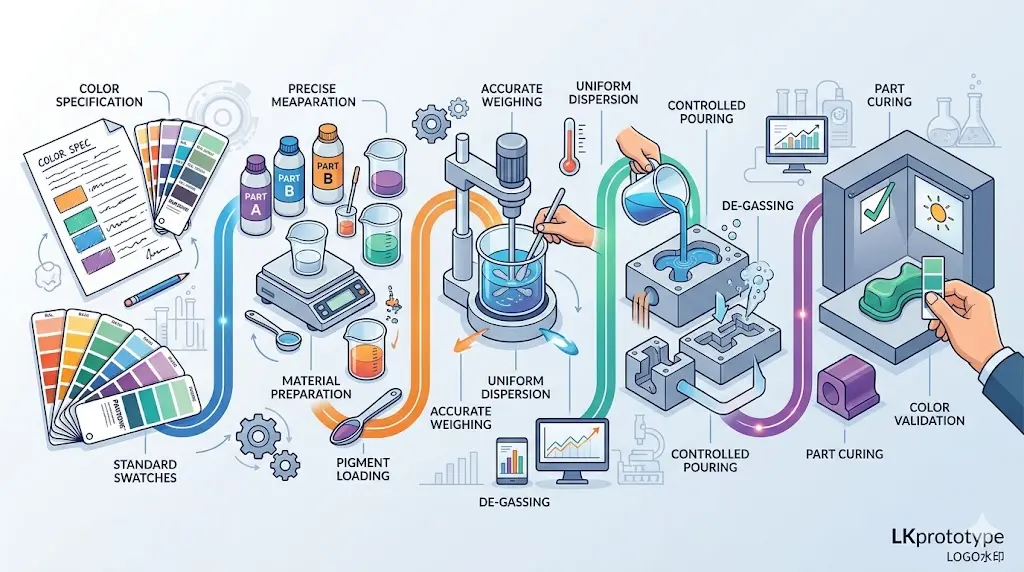
OVERVIEW OF THE COLOR MATCHING PROCESS
You can match colors in urethane casting by using clear steps. First, pick the right pigments for your project. Then, mix these pigments with the urethane resin. Pour the mixture into molds and let it cure. After curing, check the color of your sample. If the color is not right, change the formula and try again. Doing this helps you get the same color each time.
PIGMENT SELECTION AND PREPARATION
You need to choose pigments that work well with urethane. Some pigments make bright colors, and others make softer shades. Before mixing, get the pigments ready so they spread out evenly. Here are some best ways to do this:
Coat pigments with resin first to stop clumps.
Use the right solvents to help pigments mix better.
Add wetting agents to help pigments blend with resin.
Use dispersants to keep pigments from sticking together.
Mix dispersants with pigments before adding them to resin.
These steps help you get smooth and even color in your urethane parts.
MIXING AND DISPERSION TECHNIQUES
Mixing pigments into urethane needs care and the right tools. You can use special colorants that mix well and make strong colors. The table below shows some popular choices:
Product Name | Description |
|---|---|
SO-Strong® | These are strong colorants that mix well and give even color. |
UVO® | These are color pigments that do not have phthalates and resist UV light. |
Ignite® | These are bright colorants that glow more under UV light. |
Mix pigments slowly and look for lumps. Good mixing gives you even color in every part.
SAMPLE EVALUATION AND COLOR ADJUSTMENT
After you make your sample, check the color in different lights. Sunlight and indoor lights can make colors look different. If the color does not match, change how much pigment you use or try a new mix. Write down what you do. This helps you get good results next time you do urethane casting.
COLOR STANDARDS FOR URETHANE CASTING AND PROTOTYPE COLOR MATCHING
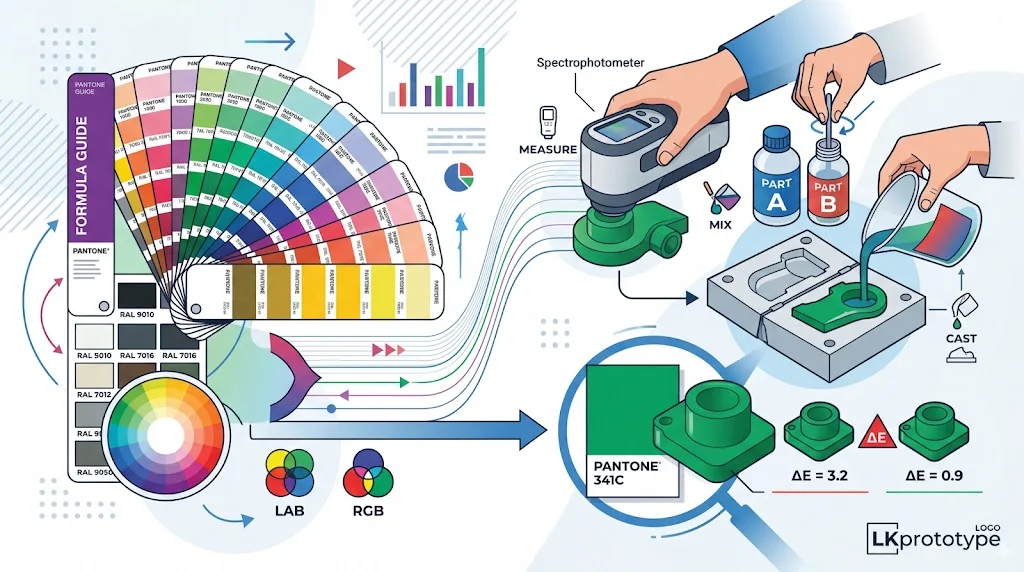
PANTONE COLOR MATCHING IN URETHANE CASTING
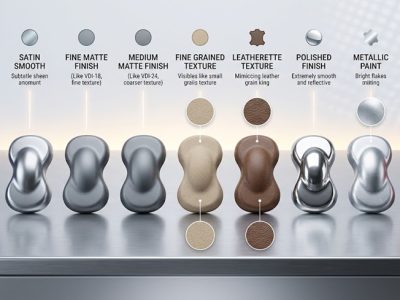
Pantone color matching helps your parts look the same each time. Pantone is a color system that many companies use. In urethane casting, you add pigment to the liquid urethane to get close to your Pantone color. For the best match, you might need to paint the part after casting, especially for light colors. Here is a table that explains how Pantone color matching works in urethane:
Aspect | Details |
|---|---|
Pigment goes into liquid polyurethane to get a close color. | |
Precise Color Matching | Painting is best for exact matches, mostly for light colors. |
Tolerances | ± 0.010 inch or ± 0.003 inch per inch, with shrinkage of + 0.15%. |
RAL COLOR MATCHING FOR PLASTIC PARTS
RAL color matching is another way to match colors for urethane plastic parts. RAL is a color standard that many people know. To match a RAL color, you give your color choice to the company making your parts. The company adds color to the urethane to get very close to your target. For the closest match, you can use Lab* color values and sometimes paint the part. Here are the steps you follow:
Give your Pantone or RAL color choice to the company.
The company colors the urethane to match your color.
For the best match, use Lab* values and think about painting.
You should expect a small difference and a little shrinking in the final part.
CUSTOM COLOR MATCHING METHODS
Sometimes, you want a color that is not in Pantone or RAL. You can use custom color matching for these times. You should make a color standard program to keep your colors the same in every batch. You can also ask paint suppliers if they can make a new color for you. Custom color matching is good when pigments change or you want a special look.
Custom color matching is needed when other systems do not work.
A color standard program keeps batches the same.
Paint suppliers can help you make new color mixes.
COLOR MEASUREMENT TOOLS AND TECHNOLOGY
Color measurement tools help you check your results. Tools like spectrophotometers measure color very well. These tools help you compare your urethane parts to Pantone, RAL, or custom colors. You can use these tools to find small color changes and fix problems before making lots of parts. Good tools help you keep your colors right every time.
Tip: Always look at your parts in different lights to make sure the color looks good everywhere.
BEST PRACTICES FOR CONSISTENT COLOR MATCHING IN PROTOTYPES
SUPPLIER COMMUNICATION AND SAMPLE APPROVAL
You need to talk clearly with your supplier. Share your color goals and give them color samples or codes. Ask for a sample part before full production. Check the sample in sunlight and indoor light. If the color matches your needs, approve the sample. If not, ask for changes. Good communication helps you avoid mistakes and keeps your project on track.
Tip: Always keep a record of your approved samples. This helps you compare future batches and spot any color changes.
ENVIRONMENTAL AND PROCESS CONTROL
You must control your workspace to keep colors consistent. Keep the temperature steady. Make sure humidity stays low. Clean your tools before mixing pigments. Use the same mixing speed and time for every batch. If you paint your parts, use high-quality paints. These paints help your colors stay bright and resist fading from sunlight. Painting also lets you pick from more colors and change how shiny your parts look. Remember, painting adds a step and can cost more.
Control Factor | Why It Matters |
|---|---|
Temperature | Stops color shifts |
Humidity | Prevents curing issues |
Clean Tools | Avoids pigment contamination |
Paint Quality | Keeps color strong and durable |
RECORD KEEPING AND BATCH TRACKING
You should track every batch you make. Write down the pigment type, amount, and resin lot number. Keep notes about mixing times and temperatures. If you see color changes, check your records to find the cause. Batch tracking helps you fix problems fast and keeps your colors consistent.
Record pigment and resin details for each batch.
Note mixing times and conditions.
Compare new batches to your approved sample.
Keeping good records makes it easier to spot mistakes and improve your process. You build trust with your clients when you show them your tracking system.
TROUBLESHOOTING COLOR MATCHING ISSUES IN URETHANE CASTING
ADDRESSING COLOR VARIATIONS
You might see color changes in your urethane cast parts. This can happen if the molds are dirty. Leftover stuff in molds can mess up the color. Always clean your molds before you start a new batch. If you notice color problems, check your tools for old pigment or resin. You can fix color changes by mixing pigments longer and using good tools. Test your samples before making lots of parts. Check your samples in sunlight and inside light. This helps you find color problems early.
Tip: Clean your molds and tools after every batch. Doing this stops most color problems.
MANAGING MATERIAL AND PROCESS CHANGES
You should watch for changes in materials and how you work. If you use a new resin lot or a different pigment brand, the color might change. Write down details for every batch you make. Record the resin lot number, pigment type, and mixing time. If you change the temperature or humidity, the color can look different. Use the same settings for each batch you make. When you change something, make a small test batch first. Compare the color to your approved sample. This helps you catch problems before they spread.
Write down every change you make.
Test new materials with a small batch first.
Check samples against your color standard.
PREVENTING COLOR INCONSISTENCY
You can stop color problems by following easy steps. Pick colorants that do not fade from heat. Try not to change colors a lot during production. Write down your color codes and how much you use. Keep areas where colors mix simple. Make sure the barrel temperature stays the same. Clean your tools between batches. Use tools that measure pigments well.
Preventive Measure | Description |
|---|---|
Use stable colorants | Choose colorants that do not fade from heat. |
Avoid frequent transitions | Make fewer color changes to keep colors steady. |
Specify color codes | Write down RAL or Pantone codes and amounts for each batch. |
Limit complex zones | Keep mixing areas simple to avoid color problems. |
Maintain barrel temperature | Keep the barrel at the right temperature for colorants. |
Clean equipment | Clean tools and machines between batches to stop mixing colors. |
Use proper dosing | Measure pigments carefully for each batch. |
Note: Good records and steady steps help you keep colors the same in every batch.
FAQ
HOW TO MATCH COLORS IN URETHANE CASTING
You can match colors in urethane casting by following a few important steps. Most materials allow for custom color matching, so you can get the look you want for your parts.
Choose pigments that work well with your urethane resin.
Mix the pigments into the resin until the color looks even.
Pour the mixture into your mold and let it cure.
Check the finished part under different lights to make sure the color matches your sample.
Adjust the pigment amount if you need a closer match.
You should always test a small batch first. This helps you avoid wasting materials and time.
WHAT IS THE BEST WAY TO MATCH PANTONE COLORS IN PROTOTYPES
You can get the best Pantone color match in prototypes by using a careful painting process.
Mix your resin and hardener with the correct ratio. Mix well so the part cures properly.
Clean the part’s surface to remove dust or oil.
Lightly sand or etch the surface. This helps the paint stick.
Apply a thin layer of automotive primer.
Spray several thin coats of automotive lacquer in your Pantone color.
Thin coats give you a smooth finish and help the color look even.
HOW ACCURATE IS COLOR MATCHING IN VACUUM CASTING
You can achieve good color accuracy in vacuum casting. The process lets you control pigment mixing and curing. You may see small differences between batches, but you can reduce these by keeping your process steady and checking each batch against your approved sample.
WHAT CAUSES COLOR DIFFERENCES IN CASTING PARTS
Many things can cause color differences in your urethane cast parts.
The base color of the urethane can change the final color. For example, a white base with red pigment may look pink.
Moisture in the resin during curing can make colors uneven.
The heat from the curing reaction can shift the color.
Some colorants may not work well with your urethane and can change the color or finish.
HOW TO IMPROVE COLOR CONSISTENCY IN PRODUCTION
You can improve color consistency by using the same materials and following the same steps every time. Keep your workspace clean and control the temperature and humidity. Always record your pigment amounts and resin lots. Test each batch before making many parts. This helps you catch problems early and keep your colors looking the same.
You can get good color matching in urethane casting by following simple steps. Use trusted standards and write down what you do. Talk often with your supplier to stop mistakes. Keep your process steady to help things go well. The table below shows how using best practices and checking data right away can help:
Practice | Benefit |
|---|---|
Centralized color management | Fewer color mistakes and better tracking |
Real-time color measurement data | Everyone knows the color goals |
Accurate, up-to-date data | Better chance to hit the right color |
Stay neat and talk with your team often to get the right color each time.
How do you match colors in urethane casting?
You start by picking the right pigment. You mix it into the urethane resin. You pour the mix into a mold. You check the color after curing. You adjust the pigment if needed.
What is the best way to get a Pantone color in prototypes?
You can use special pigments or paint your part after casting. You show your supplier the Pantone code. You ask for a sample. You compare the sample to your color chart before making more parts.
How accurate is color matching in vacuum casting?
You can get close matches with good process control. Small differences may happen. You check each batch against your approved sample. You keep records to help spot changes.
What causes color differences in casting parts?
You may see color changes from different resin lots, pigment types, or mixing times. Temperature and humidity can also affect color. You keep your process steady to reduce these problems.
How do you improve color consistency in production?
You use the same materials and steps for every batch. You keep your workspace clean. You control temperature and humidity. You record pigment amounts and resin lots. You test each batch before making many parts.