LKprototype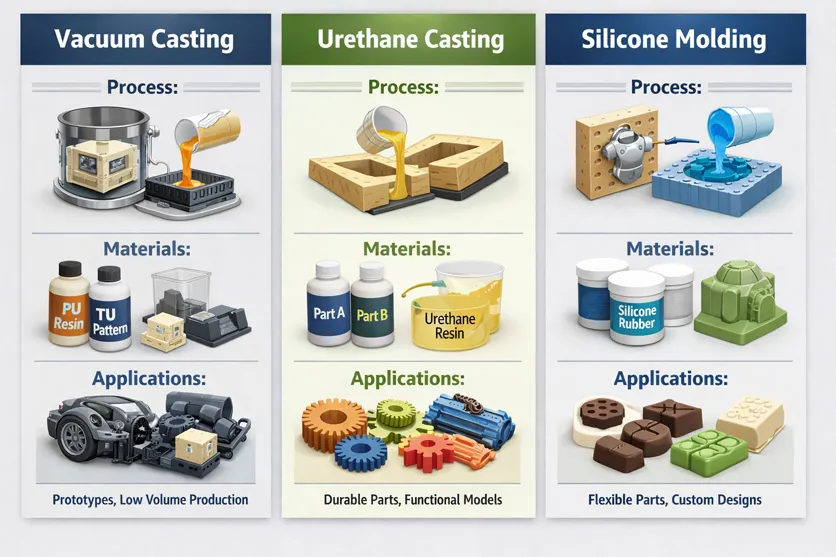
When you look at vacuum casting vs urethane casting, along with silicone molding, you have to make choices. These choices can change how fast you finish your product. Picking the right casting process can help you go from design to part faster. Mold design, material prep, and post-processing all change your schedule:
Factor | Impact on Timeline |
|---|---|
Mold Design and Creation | Hard molds take more time to make and design. |
Material Selection and Preparation | The kind of metal and how you get it ready can change the timeline. |
Casting Method | Each casting method, including vacuum casting vs urethane casting, takes a different amount of time. |
Curing and Cooling Time | Bigger castings need more time to cool and stay strong. |
Post-processing Requirements | You need extra time for cleaning, cutting, and finishing. |
Inspection and Testing | Checking quality adds more time to the whole process. |
Vacuum casting and urethane casting are sometimes similar. But each has its own steps and results. Knowing these differences helps you pick the best method for your project.
Key Takeaways
Learn how vacuum casting, urethane casting, and silicone molding are different. This helps you pick the best way for your project.
Vacuum casting works well for making detailed prototypes. It is also good for making small batches. Urethane casting lets you use different materials.
Silicone molding helps make shapes that are hard to create. You can use the mold many times. This saves money when testing designs.
Think about how fast you need parts and how much it costs. Vacuum casting and urethane casting are fast for small jobs. They usually take 3 to 7 days.
Look at what your project needs. Check the size of the part, how much detail you want, and what materials you need. This helps you pick the right casting process.
Vacuum Casting vs Urethane Casting vs Silicone Molding Overview
What These Casting Processes Have in Common
Vacuum casting, urethane casting, and silicone molding all begin with a master pattern. This pattern is made using 3D printing or CNC machining. Each process uses a mold, usually made from silicone, to shape the parts. Liquid material is poured into the mold. The material cures inside the mold. After curing, you take out the finished part. These methods help make parts with smooth surfaces and lots of detail. They are good for making prototypes and small batches.
You get these benefits from all three methods:
You can copy complex shapes from a master model.
You get parts quickly for small production runs.
The parts have smooth surfaces and good detail.
You can pick from different materials.
Tip: All three methods let you test your designs before making lots of parts.
Key Differences Between Vacuum Casting, Urethane Casting, and Silicone Molding
These casting methods have many steps that are alike. But there are important differences in how they work and what they do. The table below shows the main steps for vacuum casting and urethane casting. Both start with a digital 3D model. They make a master model and pour silicone over it using a vacuum. Resin is poured into the mold under vacuum. Then the part cures and is finished.
Process Step | Vacuum Casting | Urethane Casting |
|---|---|---|
CAD Design | Digital 3D model made with CAD software | Digital 3D model made with CAD software |
Creating the Master Model | Master model made by 3D printing or CNC | Master model made by 3D printing or CNC |
Making the Silicone Mold | Silicone poured over master model with vacuum | Silicone poured over master model with vacuum |
Casting the Parts Under Vacuum | Resin poured into mold with vacuum | Resin poured into mold with vacuum |
Curing, Demolding, and Finishing | Resin cures, mold opened, part removed | Resin cures, mold opened, part removed |
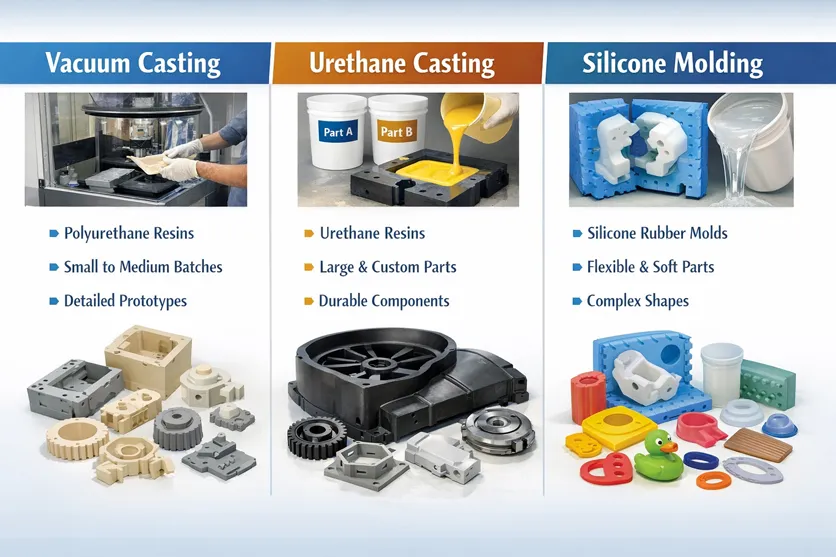
When you look at vacuum casting, urethane casting, and silicone molding, you see special features. Vacuum casting is good for making parts with lots of detail. It uses silicone molds and works best for small batches. Urethane casting uses similar steps but may use other materials. Silicone molding is about making the mold, which can be used for other casting methods.
Feature | Vacuum Casting | Urethane Casting | Silicone Molding |
|---|---|---|---|
Master Pattern | Yes | Yes | Yes |
Mold Material | Silicone molds | Varies | Silicone |
Production Volume | Best for small batches | Varies | Varies |
Complexity of Parts | Handles complex shapes | Limited | Limited |
Cost-effectiveness | Not best for high volume | Varies | Varies |
Pick the process that fits your project. Vacuum casting is best for detailed, low-volume parts. Urethane casting lets you use different materials. Silicone molding gives you a mold you can use again for many casting types.
Process Comparison Table
Overview of Process Differences
You might ask how these casting methods are different. All three use a silicone mold to make parts. But the way you make the parts is not always the same. Vacuum casting and urethane casting both use a vacuum. The vacuum takes out air bubbles. It also helps the resin fill every small space. Silicone molding is more about making the mold itself. You can use this mold with many kinds of casting materials.
Here is a simple look at the main differences:
Process | Mold Creation | Casting Method | Typical Output per Day | Mold Lifespan |
|---|---|---|---|---|
Vacuum Casting | Silicone, under vacuum | Resin, under vacuum | 1-10 parts | 10-30 parts |
Urethane Casting | Silicone, under vacuum | Polyurethane resin, under vacuum | 1-10 parts | 10-30 parts |
Silicone Molding | Silicone, manual or vacuum | Varies (resin, wax, etc.) | Varies | 10-30 parts |
Note: Vacuum casting and urethane casting both make smooth and detailed parts. Silicone molding lets you use the same mold for different materials.
Materials, Cost, and Production Speed Comparison
When you look at vacuum casting and urethane casting, you see they use similar materials. Both can use polyurethane, epoxy, or other resins. Silicone molds work for all three casting methods.
Vacuum casting can cost 30–60% less than injection molding for small batches.
If you need more parts, injection molding is usually cheaper.
Here is a list of normal costs:
Cost Component | Price Range |
|---|---|
Small Part Mold Cost | $200 - $500 |
Large/Complex Mold Cost | $1,200 - $3,000 |
Silicone Material Cost | $100 - $300/kg |
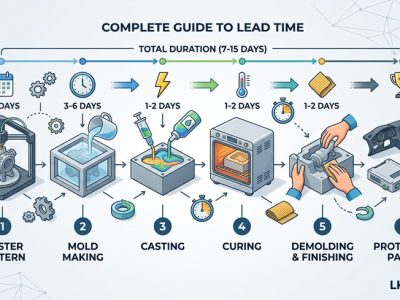
You can get your parts fast, in about 3-7 days. Each silicone mold can be used for 10-30 parts. Vacuum casting and urethane casting both make about 1-10 parts each day. This speed is good for making prototypes or small batches.
Short production time (3-7 days)
Good for small batches (10-30 parts per mold)
Vacuum casting makes about 1-10 parts per day.
Urethane casting is about as fast as vacuum casting.
If you want fast and low-cost parts for small runs, these methods are a good choice. Pick the best process by thinking about your part size, detail, and how many you need.
Vacuum Casting Process Explained
Step by Step Vacuum Casting Process
Here are the main steps for vacuum casting:
CAD Design: First, you make your part in CAD software.
Creating the Master Model: Next, you build a master model from your design. You can use 3D printing or CNC machining to do this.
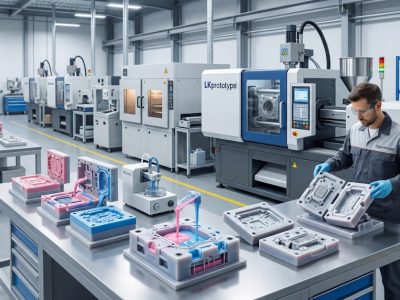
Making the Silicone Mold: Put the master model in a box. Pour liquid silicone over it. Use a vacuum to pull out air bubbles.
Casting the Parts Under Vacuum: Get the silicone mold ready. Mix the casting resin and remove air bubbles. Pour the resin into the mold using a vacuum.
Curing, Demolding, and Finishing: Let the resin harden. Open the mold and take out the part. Finish the surface if you need to.
Tip: The vacuum helps make smooth parts without bubbles.
Materials Used in Vacuum Casting
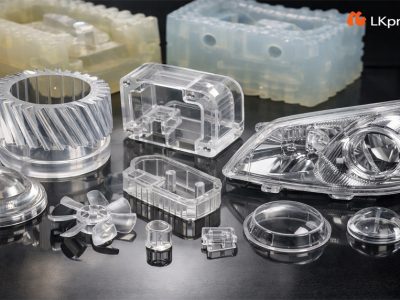
You can pick from many materials in vacuum casting. Most people use polyurethane resins. These can act like plastics such as ABS and PP. You can also use rubber-like materials for soft parts. Clear plastics are good for see-through parts.
Material Type | Description |
|---|---|
Polyurethane Resins | Act like ABS, PP, and other plastics |
Rubber-like Materials | Make flexible and tough parts |
Transparent Plastics | Good for clear or see-through parts |
Epoxy Systems | Used for special jobs |
Specialty Silicones | Give special features for casting |
Advantages and Limitations of Vacuum Casting
Vacuum casting has many good points:
You can make parts with lots of detail and smooth surfaces.
It works well for small or medium batches.
You can test your ideas before making lots of parts.
You can use many different materials.
But there are some limits:
Parts are not as strong as injection molding parts.
The process is slower because each mold needs time to harden.
It is best for small or medium parts, not big ones.
Each mold only makes about 10-30 parts.
Note: When you look at vacuum casting vs urethane casting, both have similar good and bad points. Vacuum casting is picked for its detail and finish.
Typical Applications of Vacuum Casting
Vacuum casting is used in many fields:
Industry | Applications |
|---|---|
Automotive | Dashboards, air vents, lens covers, and test parts |
Medical | Sensor cases and special shells for the body |
Aerospace | Light parts inside planes, like ducts and wall panels |
Consumer Products | Wearable tech, grips, and testing new designs |
Electronics | Cases and panels that look and work a certain way |
Vacuum casting helps you make prototypes and small batches for real tests. You can see if your design works before making lots of parts.
Urethane Casting Process Explained
How Urethane Casting Works
Urethane casting is a way to make strong parts. These parts can have lots of detail. You use polyurethane resins for this process. First, you need a master model. This is just like in vacuum casting. You pour silicone over the model to make a mold. When the mold is hard, you mix the polyurethane resin. Then you pour the resin into the mold. A vacuum is used to pull out air bubbles. The vacuum also helps the resin fill every small space. Urethane casting is a special kind of vacuum casting. It uses thermoset polymers, mostly polyurethane. This makes parts with special features. Vacuum casting can use many materials. Urethane casting uses mostly polyurethane because it has special qualities.
Polyurethane Materials Used in Casting
There are different types of polyurethane you can pick. Each type is good for different jobs.
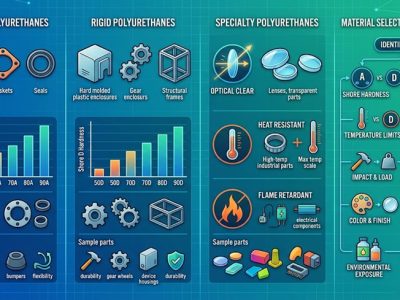
Type of Polyurethane | Characteristics | Applications |
|---|---|---|
Rigid Urethanes (Shore D) | High strength, tight tolerances, thermal resistance | Structural parts, housings, enclosures |
Flexible Urethanes (Shore A) | Softness, rebound, environmental performance | Seals, gaskets, vibration-dampening elements |
High-Performance and Specialty Urethanes | Enhanced resistance to heat, abrasion, chemicals | Industrial equipment, automotive components |
Tip: Choose the right polyurethane to get the look and feel you want.
Advantages and Drawbacks of Urethane Casting
Urethane casting has many good points for making small numbers of parts. But there are some things you should know about its limits.
Advantages | Drawbacks |
|---|---|
Cost-effectiveness | Lower durability compared to injection molding |
High dimensional accuracy | Limited scalability for high-volume production |
Reduced material waste | Mold degradation after 25 to 50 cycles |
Heat resistance limits (up to 120 °C) | |
Slower production for high volume needs | |
Environmental sensitivity affecting quality |
You get parts that are accurate and not too expensive. But the molds do not last forever. They wear out after many uses. Urethane parts may not last as long as injection-molded parts. This is true if they get very hot.
Common Applications of Urethane Casting
Urethane casting is used for many products and industries:
Medical device housings for testing and treatment tools
Cases for electronics when you need to test them
Marine and airplane parts that must be light and strong
Shoe and fashion samples with special textures
Seals, gaskets, and insulators for many uses
Urethane casting lets you test your ideas. You can change designs fast. You get parts that look and feel like real products.
Silicone Mold Casting Process
Silicone Mold Making Process
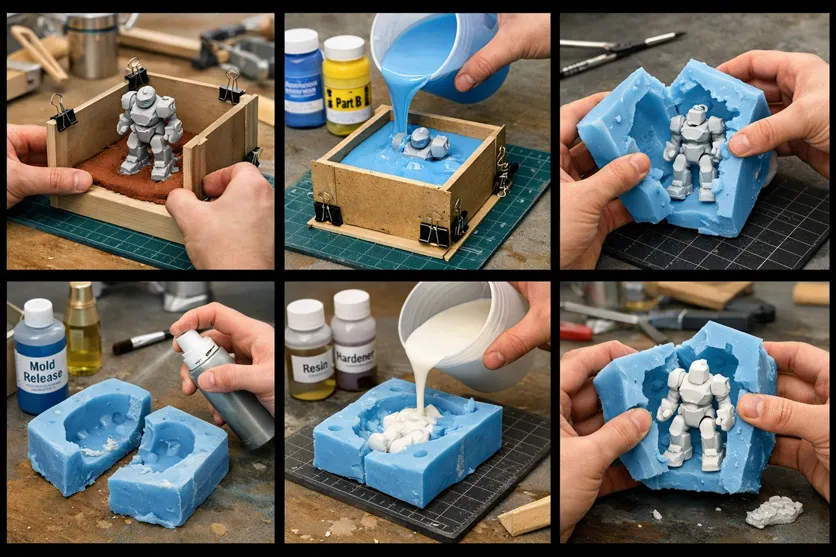
You can make detailed parts with silicone mold casting by following easy steps. Here is what you do: First, design a master pattern. This pattern will shape your final part. Next, pour liquid silicone over the master pattern to make a mold. After the silicone mold is ready, mix and pour urethane resin into it. Let the resin harden inside the mold. Then, take out the finished part. You can clean and finish the part to make it look better. If your part is thick or has a tricky shape, you can use pressure curing.
Tip: Pressure curing helps stop bubbles in thick parts.
Types of Silicone Molds
There are different types of silicone molds you can pick. Each type is good for certain jobs.
Mold Type | Characteristics | Best Use Cases |
|---|---|---|
RTV Platinum- and Tin-Cure | These molds shrink less and keep their shape. They also show small details well. | Good for making prototypes and small batches. |
HTV Silicone | These molds last longer and are strong. They can handle heat better. | Good for medium batches and parts that need to look nice. |
Benefits and Limitations of Silicone Molding
Silicone molding works well in tough places. You can use it for parts that get hot or touch chemicals. Silicone molds work from -60°C to 250°C. They are safe for medical devices because they are biocompatible. But silicone is not as strong as polyurethane. Polyurethane parts do not tear or wear out as fast. If your part needs to be very tough, urethane casting might be better. Think about if you need your part to last long or be safe for people.
Best Use Cases for Silicone Mold Casting
Silicone mold casting is best for testing new ideas or making a few parts. It helps you try out designs without spending a lot of money.
You can make 10 to 100 parts in a batch.
You can design shapes that are hard to make other ways.
You do not need to spend much on tools for test runs.
Use Case | Advantages |
|---|---|
Automotive | You can make tricky shapes and small batches. |
Medical Devices | You can test new designs fast. |
Aerospace | You can make light and detailed parts. |
Consumer Products | You can test new ideas without spending a lot. |
Electronics | You can make real-looking samples without high costs. |
Note: Silicone mold casting helps you go from idea to part fast and without spending too much.
Vacuum Casting vs Urethane Casting vs Silicone Molding
Process Differences and Production Workflow
| Process | Materials | Production Volume | Cost Level | Typical Use |
|---|---|---|---|---|
| Vacuum Casting | PU resins | Low | Medium | Functional prototypes |
| Urethane Casting | Polyurethane | Low–Medium | Medium | Small batch production |
| Silicone Molding | Silicone molds + resin | Low | Low | Prototype parts |
Each process works in its own way. Urethane casting is good for making a small number of strong plastic parts. You pour liquid polyurethane resin into a silicone mold you can use again. This way, you get parts with lots of detail. It also works for shapes that are hard to make. The molds are soft, so you do not spend as much money as with injection molding. The parts dry at room temperature, so you get them fast, usually in three to five days.
Here is a simple chart about each method:
Method | Process Description | Material Used |
|---|---|---|
Liquid resin goes into a silicone mold with a vacuum. | Mostly polyurethane resins | |
Like vacuum casting but always uses polyurethane resins. | Polyurethane-based resins | |
Silicone Molding | This method can use many materials and ways to cast. | Many different materials |
Material Performance Comparison
Both vacuum casting and urethane casting use polyurethane resins. Vacuum casting is good for making a small or medium number of parts. Urethane casting lets you pick from more types of materials. You can choose what works best for your project. Both ways let you make tricky shapes and change designs fast.
Factor | Vacuum Casting | Urethane Casting |
|---|---|---|
Material Options | Mostly polyurethane resins | Many kinds of urethane resins |
Cost Efficiency | Cheaper molds | Costs more for big batches |
Design Flexibility | Good for hard shapes | Easy to change designs |
Vacuum casting resins are not as strong as engineering plastics. But they are fine for testing ideas and making a few parts.
Cost and Production Volume Comparison
You might wonder how many parts you can make and what it costs. Urethane casting is best for making between ten and one hundred parts. The molds do not cost much and are quick to make. If you need thousands of parts, injection molding is better. The price for each part goes down when you make a lot.
Factor | Urethane Casting | Injection Molding |
|---|---|---|
Production Volume | Small to medium (10–100 parts) | Large (1,000+ parts) |
Tooling Cost | Low, uses silicone molds | High, uses metal molds |
Cost per Part | More expensive for big batches | Cheaper when making lots of parts |
Typical Industry Applications
These methods are used in many fields. Here are some examples:
Industry | Application Type |
|---|---|
Automotive | Test parts and custom car pieces |
Medical Devices | Testing new medical tools |
Aerospace | Making airplane parts |
Consumer Products | Creating new products for people |
Electronics | Testing new electronic parts |
These processes help you try out ideas, make special parts, and get products ready faster.
How to Choose the Right Casting Process
Choosing Based on Project Requirements
Think about what you want for your project before you pick a casting process. First, look at the shape and size of your part. If your part has lots of small details, vacuum casting or silicone molding can help you get them right. Urethane casting is good if you need parts that are strong and can bend. Ask yourself how many parts you need to make. If you only need a few, vacuum casting or urethane casting is a good choice. If you need a lot, you might need a different process. You should also think about if you want your part to be smooth or have a special finish.
Tip: Make a list of your main needs. This will help you pick the best casting process for your project.
Cost and Production Speed Considerations
How much you spend and how fast you get parts is important. Vacuum casting and urethane casting do not cost much to start. They are quick to set up. You can get test parts fast and save money. If you need a lot of parts, high-pressure die casting costs more at first but is cheaper for big batches. If you want parts quickly and do not need many, vacuum casting or urethane casting is a good pick. Remember, if you want your parts polished or painted, it will cost more.
Material and Mechanical Performance
You need to think about how your part will work. Each casting process changes how the material acts. Vacuum casting gives you a nice surface and is very accurate. Urethane casting lets you pick materials that are strong or can bend. Silicone molding is good for parts that need to handle heat or chemicals. Think about these things:
How hard the part is to make
What kind of material you need
How smooth you want the part to be
How many parts you need
Pick the casting process that matches what your part needs to do. This helps your part work the way you want.
Expert Recommendations for Prototyping and Low Volume Production
Experts say different casting methods are best for different jobs. Look at this table to see which one fits your needs:
Casting Process | Ideal Use Cases | Tooling Cost Considerations |
|---|---|---|
Investment Casting | Aerospace, medical, precision industrial applications | Higher per-part costs, justifiable for performance |
Gravity Casting | Medium volumes of simple to moderately complex parts | Relatively low tooling costs, good mechanical properties |
Centrifugal Casting | Cylindrical parts like pipes and rings | Modest tooling costs, excellent material integrity |
Permanent Mold Casting | Low- to medium-volume manufacturing | Lower tooling costs than HPDC, improved accuracy |
Sand Casting | Simple, large parts with minimal finish demands | Low tooling costs, higher per-part costs |
High-Pressure Die Casting | Complex geometries and thin-walled structures | High tooling costs, low per-part costs at high volumes |
Low Pressure Die Casting | Specialty applications needing strength and precision | Higher costs justified for critical applications |
Note: Vacuum casting and urethane casting are good for making test parts and small batches. These ways save time and money and give you detailed parts.
Now you know how vacuum casting, urethane casting, and silicone molding are alike and different. Each one is good for certain jobs. Look at this table to see which process fits your project best:
Method | Volume | Application | Material Properties |
|---|---|---|---|
Vacuum Casting | Low to Medium | Functional prototypes, design validation | High-quality plastic parts |
Urethane Casting | Low to Medium | Short-run production | Polyurethane resin |
Silicone Molding | Varies | High-precision replication | Flexible silicone rubber |
Vacuum casting is great for making a few detailed prototypes.
Urethane casting uses silicone molds to make strong polyurethane parts.
Silicone molding helps you make shapes that are very exact.
Think about what your project needs. Picking the right casting process will help you get the best outcome.
FAQ
What is the main difference between vacuum casting and urethane casting?
Vacuum casting uses a vacuum to pull out air bubbles. It also helps fill the mold all the way. Urethane casting always uses polyurethane resin. Both use a vacuum, but urethane casting is about the material you use.
Can you reuse silicone molds?
You can use silicone molds again for 10 to 30 parts. The mold gets worn out after you use it many times. If you want more parts, you need to make a new mold.
Which process gives the best surface finish?
Vacuum casting makes the smoothest surface on your parts. The vacuum takes away bubbles and fills in every detail. The parts look almost as good as injection-molded ones.
How fast can you get parts with these methods?
You can get your parts in about 3 to 7 days. Each mold can make 1 to 10 parts every day. These ways are good if you need parts fast for testing or small batches.
What materials can you use in silicone molding?
You can use lots of materials in silicone molding. Some common ones are polyurethane, epoxy, wax, and some metals for low heat casting. Pick the material that works best for your project.