LKprototype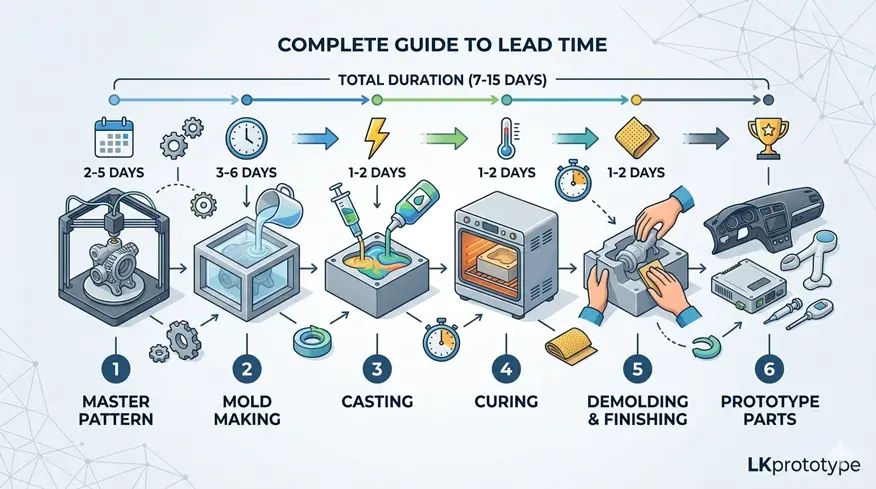
You usually see urethane casting lead time for prototype parts is one to three weeks. Vacuum casting can give you parts in about ten days. Getting parts fast is important for your project schedule. New changes in the industry help you even more:
- Customized low-viscosity systems now ship in one week from Wanhua’s Chongqing plant.
- Special lines have made castor lead times shorter, from eight weeks to four weeks.
If you want a full guide to speed and efficiency, you should know these facts. This guide gives you what you need to plan your prototypes with confidence.
Key Takeaways
- Urethane casting usually gives you prototype parts in one to three weeks. This is faster than older ways of making parts. Vacuum casting can make parts in about ten days. This is great for quick prototyping and fast design changes. Good communication with your supplier helps avoid delays. It also helps make sure you get your parts on time. Using design for manufacturability (DFM) can make the process smoother. This saves time and lowers costs. Picking fast-curing materials and getting them ready early can make lead times much shorter.
URETHANE CASTING LEAD TIME OVERVIEW
WHAT IS URETHANE CASTING LEAD TIME
You should know what urethane casting lead time means before starting. This is the total time from making silicone molds to getting your finished prototype parts. Urethane casting lead time is much shorter than older ways of making things. For example:
- You can get silicone molds ready for urethane casting in one to two weeks.
- Traditional injection molding can take four to twelve weeks or even longer.
A shorter lead time helps you keep your project moving without waiting a long time.
TYPICAL URETHANE CASTING TIMELINE 1 TO 3 WEEKS
With urethane casting molding, you usually get your prototype parts in one to three weeks. First, you make a master pattern. Next, you create the silicone mold. Then, you cast with urethane. Each step takes some time, but the whole process is much faster than other ways. You can plan for a fast turnaround. This means you can test your designs and make changes quickly.
Tip: If you want your parts fast, ask your supplier about their schedule and how busy they are.
FAST TURNAROUND WITH VACUUM CASTING PROCESS
Vacuum casting gives you the fastest results in urethane casting. You can get your parts in about 10 days from starting the master model to getting your finished products. The whole vacuum casting process, from making the mold to casting and curing, can finish in just a few days. This speed lets you change your design and check your ideas quickly.
- Vacuum casting is great for rapid prototyping and bridge production.
- You do not have to pay high upfront costs like with older methods.
- You can react to market changes fast and stay ahead of others.
Vacuum casting is the best choice when you need parts quickly and want good results for small batches.
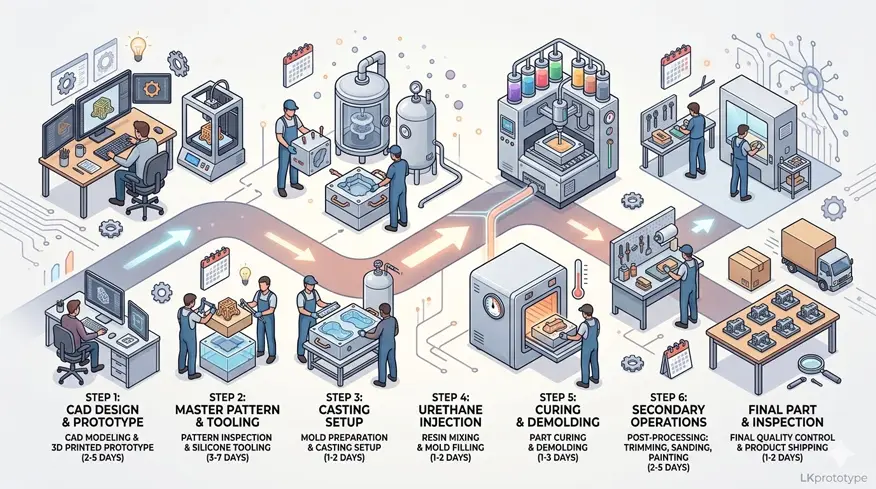
STEP BY STEP URETHANE CASTING TIMELINE
MASTER PATTERN CREATION TIME
The first step is making a master pattern. You can design your part with CAD software. CNC machining or 3D printing makes the pattern. Most patterns are done in three to seven days. The size and shape of your part can change the time needed. If you use vacuum casting, you need a good master pattern for the best results.
SILICONE MOLD MAKING AND CURING TIME
After you finish the master pattern, you make a silicone mold. Put the pattern in a mold box. Pour liquid silicone around the pattern. The silicone cures in an oven for eight to sixteen hours at about 40 degrees Celsius. Some brands may need more or less time. Vacuum casting uses silicone molds because they bend and are easy to use. When the silicone is cured, take out the master pattern. This leaves a space for your part.
URETHANE CASTING AND VACUUM POURING TIME
Mix two parts of urethane resin with colors or other things. Put the mix in a vacuum chamber to get rid of bubbles. Pour the resin into the silicone mold. Vacuum casting helps keep the part free of bubbles. You can make up to twenty parts in fifteen days or less. Put the mold in a vacuum chamber again for a smooth finish.
CURING AND DEMOLDING TIME
The urethane part gets hard inside the mold. You can heat the mold to sixty to eighty degrees Celsius for one to four hours. Heating makes the part cure faster and look better. Vacuum casting helps you get strong and clear parts. After curing, open the mold and take out the part carefully.
POST PROCESSING AND FINISHING TIME
Cut off extra material from the part. You can paint, add texture, or machine the part to fit your needs. Vacuum casting makes finishing easier because the silicone mold gives a smooth surface. Check the part for quality and get it ready for testing or use.
Tip: Vacuum casting gives you fast and high-quality prototype parts. You can do this process again for small batches and make changes quickly.
| Step | Typical Time Needed |
|---|---|
| Master Pattern Creation | 3-7 days |
| Silicone Mold Making | 8-16 hours |
| Urethane Casting | 1-2 hours per batch |
| Curing and Demolding | 1-4 hours |
| Post Processing | 1-2 hours |
FACTORS AFFECTING URETHANE CASTING LEAD TIME
MOLD CREATION TIME AND COMPLEXITY
Making the mold is a big part of urethane casting lead time. Simple molds are quick to make. Molds with lots of details or moving parts take longer. If you want your parts to be very exact, you need more time for careful mold work. The steps are designing, building, and curing the mold. Each step changes how fast you get your parts. When you need small or medium parts with tiny details, making the mold just right matters even more.
| Factor | Description |
|---|---|
| Tooling Methods | Traditional tooling costs more and takes longer, but it is good for making lots of parts. Newer methods are faster for small batches. |
| Project Timelines | Your schedule can change which tooling method you pick, and this affects how long everything takes. |
| Budget Constraints | Your money matters for picking tooling; old ways may be cheaper for big jobs, but fast methods are better for prototypes. |
| Advancements in Technology | New things like patternless tooling and 3D-printed molds make the process quicker and more flexible, which changes lead times a lot. |
MATERIAL SELECTION AND CURING SPEED
You can pick from many urethane casting materials. Each one cures at its own speed. Some cure fast, others take longer. Fast-curing materials help you get parts sooner. If you need parts to be very exact or special, you might need a material that cures slowly. The best choice depends on what your project needs and how you plan to use urethane casting.
PART DESIGN AND GEOMETRY COMPLEXITY
The shape and design of your part can change how long it takes. Simple shapes are quicker to cast. Hard designs with thin walls or deep channels need more time and care. Urethane casting is good for tricky shapes and working parts. You can get exact parts and nice surfaces even with tough designs. This lets you try new ideas fast.
| Aspect | Urethane Casting Benefits | Traditional Injection Molding Constraints |
|---|---|---|
| Lead Time | Makes complex shapes quickly | Takes longer because of tooling |
| Design Flexibility | Handles detailed designs easily | Needs careful planning for parting lines |
| Material Options | Can use many materials for prototypes | Only one material per mold |
| Cost | Costs less at the start | Costs more at first for tooling |
| Iteration Speed | Lets you test and change designs fast | Slower because tooling must be changed |
| Surface Quality | Gives smooth surfaces | Depends on how good the mold is |
| Complexity Handling | Makes thin and deep parts easily | Needs special tooling for hard shapes |
PRODUCTION VOLUME AND BATCH SIZE
Think about how many parts you need. Urethane casting works best for small to medium batches. Making more parts can lower the cost for each one, but it can take more time. Mold making time matters here. If you want a big batch, designing, making, and curing the mold can take longer. For small batches, you get parts faster and better quality.
- Urethane casting is best for small to medium batches.
- It does not work well for making lots of parts, where injection molding is better.
| Factor | Impact on Lead Time and Cost |
|---|---|
| Production Volume | Making more parts lowers costs, but fewer parts cost more each. |
| Lead Time for Mold Creation | Mold design, making, and curing can make the whole process take longer. |
SUPPLIER CAPABILITIES AND PROCESS EFFICIENCY
Your supplier’s skills and tools can change how fast you get your parts. Suppliers with good equipment and control can make exact parts and better quality. Some use new things like 3D-printed molds to save time. Ask about their experience with working parts and if they can handle different urethane casting jobs. Good suppliers help you meet deadlines and keep your project going.
Tip: Always check if your supplier has made small or medium parts with high precision before. This helps you avoid delays and get the best results.
HOW TO REDUCE URETHANE CASTING LEAD TIME
DESIGN FOR MANUFACTURABILITY DFM OPTIMIZATION
You can make urethane casting faster by planning your design early. Using design for manufacturability, or DFM, helps you spot problems before they slow you down. If you talk to your supplier, you can change your design to make the mold easier. This saves both time and money. Fixing the mold design at the start means you do not need big changes later. You get better parts and faster results when you plan for casting from the beginning.
Tip: DFM can help you get your first vacuum casting parts in about 7 days and make later runs faster.
RAPID MASTER PATTERN METHODS 3D PRINTING AND CNC
You can use fast master pattern methods to speed up vacuum casting. These ways help you make the first model of your part quickly. Here is a table that shows some common ways to make master patterns:
| Method | Description |
|---|---|
| 3D Printing | Builds parts layer by layer, great for complex shapes. |
| CNC Machining | Uses machines to cut strong plastics or metals with high precision. |
| Vacuum Casting | Makes many copies from silicone molds. |
| Low-volume Molding | Fast tooling for small production runs. |
When you use 3D printing or CNC machining, you get accurate master patterns for vacuum casting. These methods let you test your design and find problems early. You can move from testing and checking your design to making parts faster.
CLEAR COMMUNICATION WITH CASTING SUPPLIERS
Talking clearly with your casting supplier helps you get parts faster. Share your design files and schedules as soon as you can. If you pick a supplier who does both testing and making parts, you avoid delays. Good suppliers give you one person to talk to, clear calendars, and updates about risks. This keeps your vacuum casting project on track.
- Early help from engineers lets you fix problems before they slow you down.
- Using online tools for files and schedules helps stop mistakes.
- Real-time dashboards help you make quick choices.
Note: Talking directly to your supplier’s engineers gives you more control and better results during manufacturing.
MATERIAL PREPARATION AND INVENTORY PLANNING
You can save time by getting your materials ready before you start vacuum casting. Work with experts to pick the right urethane for your job. Some materials cure faster and help you finish sooner. If you keep materials ready, you do not have to wait for shipments. This is important when you need small batches or quick changes.
- Plan what materials you need with your supplier.
- Keep extra stock for urgent vacuum casting jobs.
- Ask about new materials that can make your parts better.
If you plan your design for urethane casting and think about each step, you make your process faster and easier.
URETHANE CASTING FOR LOW VOLUME PRODUCTION
PROTOTYPE DEVELOPMENT ADVANTAGES
Urethane casting helps you make a small number of parts. It is easy and works well for prototypes. You do not need to buy costly molds. You can test your ideas fast and change them without waiting long. Urethane casting lets you make parts in many shapes and sizes.
- You spend less money because this way costs less than old methods.
- You can try new designs and fix them before making lots of parts.
- There are many urethane materials, so you can pick what you need.
- You can make parts with hard shapes and tiny details.
- The process gives you good prototypes that are very exact.
- Silicone molds can be used many times, so you get more parts from one mold.
- You can change how the part looks and feels for each project.
- This way makes less waste, which is better for the earth.
- You do not have to risk a lot of money on tools at the start.
- Urethane casting is used in many fields like cars, planes, and medical things.
Tip: Urethane casting lets you go from testing your idea to making a few parts without extra work.
SPEED AND COST BENEFITS FOR SMALL BATCHES
You get parts fast and save money with urethane casting for small batches. The process uses silicone molds that you can make quickly. You do not have to wait a long time for tools. This means you can get parts sooner and change things right away.
- Urethane casting has cheaper molds, so it is good for small batches.
- You finish your work faster because the wait time is short.
- Injection molding takes more time and costs more for small jobs.
- For small runs, urethane casting is the best for speed and price.
- If you need more parts, you can use the same mold again.
You can trust urethane casting to help you finish your project on time and not spend too much. This way helps you meet deadlines and make good parts for every small batch you need.
URETHANE CASTING VS OTHER MANUFACTURING METHODS LEAD TIME
3D PRINTING VS URETHANE CASTING LEAD TIME
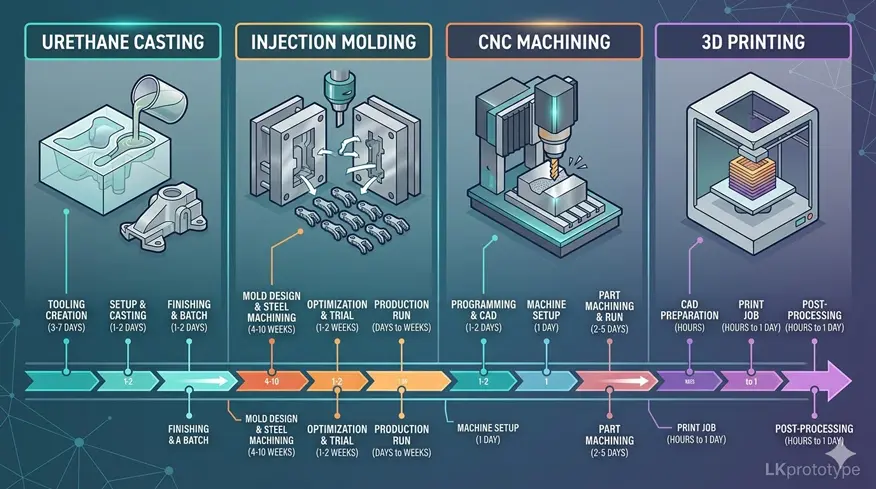
You might wonder which process is fastest. 3D printing is the quickest way to get prototype parts. You can get a 3D printed part or mold pattern in just one day. This speed lets you test ideas and change them right away.
- 3D printing helps you make mold patterns fast.
- You can use 3D printed patterns as simple prototypes before making final parts.
- Urethane casting uses these patterns to make silicone molds in one or two days.
- This mix can cut your tooling time by more than 95% compared to older methods.
If you need a few parts quickly, 3D printing is best. If you want stronger prototypes or small batches, urethane casting uses fast patterns from 3D printing to make parts in just a few weeks.
Tip: Try 3D printing for quick checks, then use urethane casting for tough, test-ready parts.
CNC MACHINING VS CASTING PRODUCTION TIME
CNC machining also gets you parts fast, but the time depends on how hard the part is and if machines are free. You can use CNC to make master patterns for urethane casting. This works well for parts that need to be very exact or use special materials.
- CNC machining gives you strong and exact parts.
- Making one CNC part can take a few days.
- Urethane casting can use CNC patterns to make molds quickly.
- For bigger batches, urethane casting is faster and costs less than CNC.
Pick CNC machining for parts that need to be very precise. For more parts or faster work, urethane casting is a better choice.
INJECTION MOLDING VS URETHANE CASTING TIMELINE
Injection molding takes longer because you need metal molds. This process is best for making lots of parts. Urethane casting uses silicone molds, which you can make much faster.
Here is a simple comparison:
| Process | Timeline |
|---|---|
| Urethane Casting | A few weeks |
| Injection Molding | As little as two weeks |
Injection molding can sometimes be as fast as urethane casting, but only after the mold is ready. Most times, urethane casting gives you prototype parts faster, especially for small batches. You do not have to wait for expensive tools or long setup times.
Note: Pick urethane casting when you need quick prototypes or small batches. Choose injection molding for big runs after you finish testing your design.
FAQ ABOUT URETHANE CASTING LEAD TIME
HOW LONG DOES URETHANE CASTING TAKE
Vacuum casting gives you prototype parts in about 10 days. Most projects finish in one to three weeks. The lead time depends on how fast you make the master pattern, the mold, and the parts. If you need parts quickly, ask your supplier about their schedule.
WHAT IS THE FASTEST PROTOTYPING METHOD
3D printing is the fastest way to make prototypes. You can get parts in just one day. Vacuum casting uses 3D printed patterns to make silicone molds. This gives you strong parts in a few days. CNC machining also helps make master patterns quickly.
Tip: Use 3D printing for quick checks. Try vacuum casting for tough prototypes.
HOW TO REDUCE VACUUM CASTING LEAD TIME
You can make vacuum casting faster by planning your design early. Use rapid master pattern methods like 3D printing or CNC machining. Keep materials ready before you start. Talk clearly with your supplier to avoid delays. Choose fast-curing urethane for shorter lead time.
- Plan your design early.
- Use quick master pattern methods.
- Keep materials in stock.
- Communicate with your supplier.
WHAT AFFECTS CASTING PRODUCTION TIME
Many things change how long vacuum casting takes. The complexity of your part, the mold design, and the material choice all matter. Production volume also affects the timeline. Suppliers with good equipment and experience help you get parts faster.
| Factor | Impact on Production Time |
|---|---|
| Part Complexity | Hard shapes take longer |
| Mold Design | Detailed molds need more time |
| Material Choice | Fast-curing urethane saves time |
| Batch Size | More parts may take longer |
| Supplier Experience | Skilled suppliers work faster |
IS URETHANE CASTING FASTER THAN INJECTION MOLDING
Vacuum casting gives you prototype parts faster than injection molding. Injection molding needs metal molds that take weeks to make. Vacuum casting uses silicone molds that you can make in days. For small batches and prototypes, vacuum casting gives you a shorter lead time.
Note: Use vacuum casting for quick prototypes and small runs. Choose injection molding for large production after testing.
You can make urethane casting lead time shorter by paying attention to mold complexity, material choice, part design, batch size, and supplier skills.
- Plan your design so it is easy to make.
- Use fast ways to make master patterns.
- Talk clearly with your supplier.
- Get materials ready before you start.
Knowing each step helps you finish on time and make your project better. When you understand the process, you can make good choices and get prototypes faster.