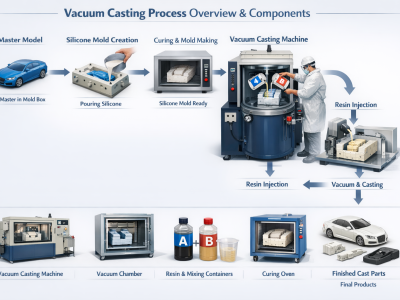
Vacuum casting is a process used to create precise prototypes and small-batch parts with silicone molds. It’s favored for its accuracy and speed, making it ideal for product development. This guide covers how vacuum casting works, the materials involved, and its benefits. Key Takeaways Vacuum casting is a precise manufacturing technique using silicone molds and vacuum environments to produce high-quality prototypes and small-batch parts. The process includes creating a master model, making silicone molds, mixing and pouring resins, and finishing the products, offering tolerances of ±0.1mm. Vacuum casting is cost-effective for low-volume production compared to injection molding and delivers superior…
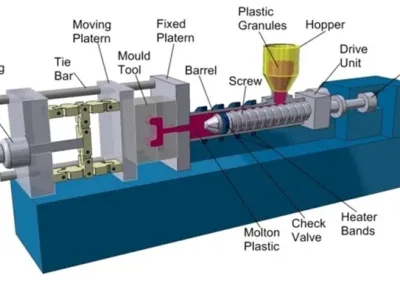
The manufacturing process does affect the cost factors, time, quality, and size. Both cast urethane and injection molding are common techniques utilized in the making of parts for the automotive, aerospace, and consumer goods industries. They get to know the best method to use depending on their manufacturing, designing, and engineering requirements. What is Cast Urethane? Cast Urethane is a casting process in which a liquid polymer is delivered in molds to form parts. It is often used for low production volume and initial part making because of the manufacturing cost, type of material, and time consumption being lower than…
Want to convert your CAD design into a sample prototype or small-batch production? Upload your files and get a fast and accurate quote.